

Buying Property in Malaysia (2026): Complete Subsale & Conveyancing Legal Guide
Buying Property in Malaysia (2026): Complete Subsale & Conveyancing Legal Guide
Buying property in Malaysia involves more than just agreeing on a price — it’s a legal process with several steps that protect both buyer and seller. From signing the Sale and Purchase Agreement (SPA) to settling stamp duty, arranging your bank loan, and completing title searches, each stage of buying property in Malaysia has its own requirements and timelines.
This guide walks you through the full subsale conveyancing process so you know exactly what to expect, what it costs, and how a conveyancing lawyer protects your interests along the way.
For a detailed overview of the legal process for a completed property, see our guide to subsale conveyancing in Penang.
About the Author
Doreen Lim is a Partner of C K LIM & PARTNERS, Penang, practising primarily in conveyancing and property law. She advises purchasers, sellers, investors and property owners on subsale transactions, financing, property transfers, foreign acquisitions, State Authority consent and other conveyancing matters, with an emphasis on identifying legal risks early and guiding clients through the transaction clearly and practically.
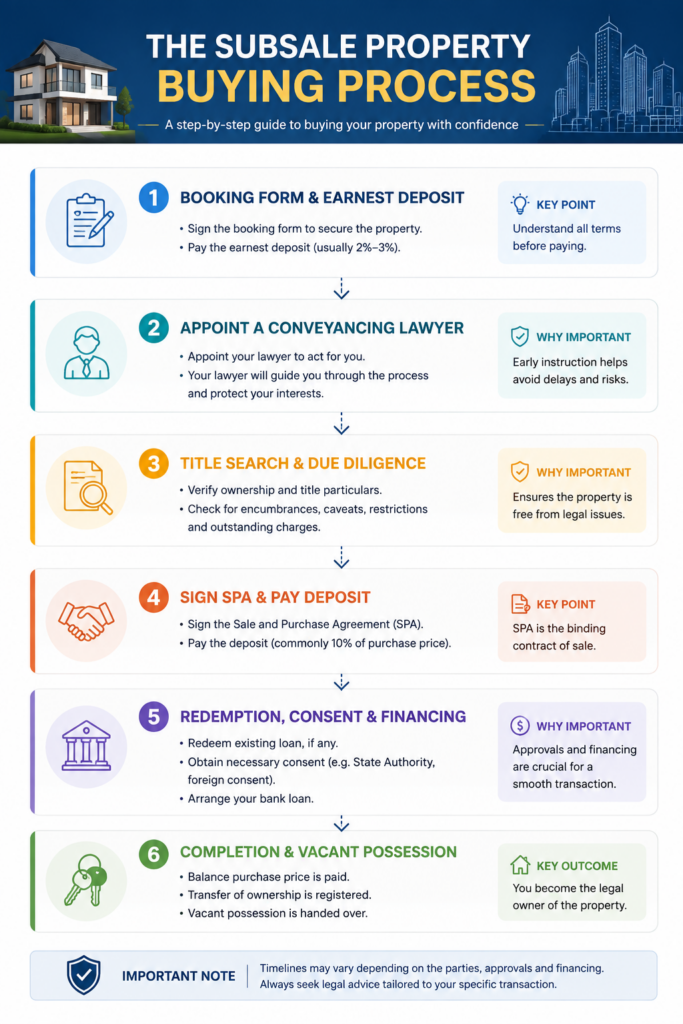
PART 1 — BEFORE YOU AGREE TO BUY
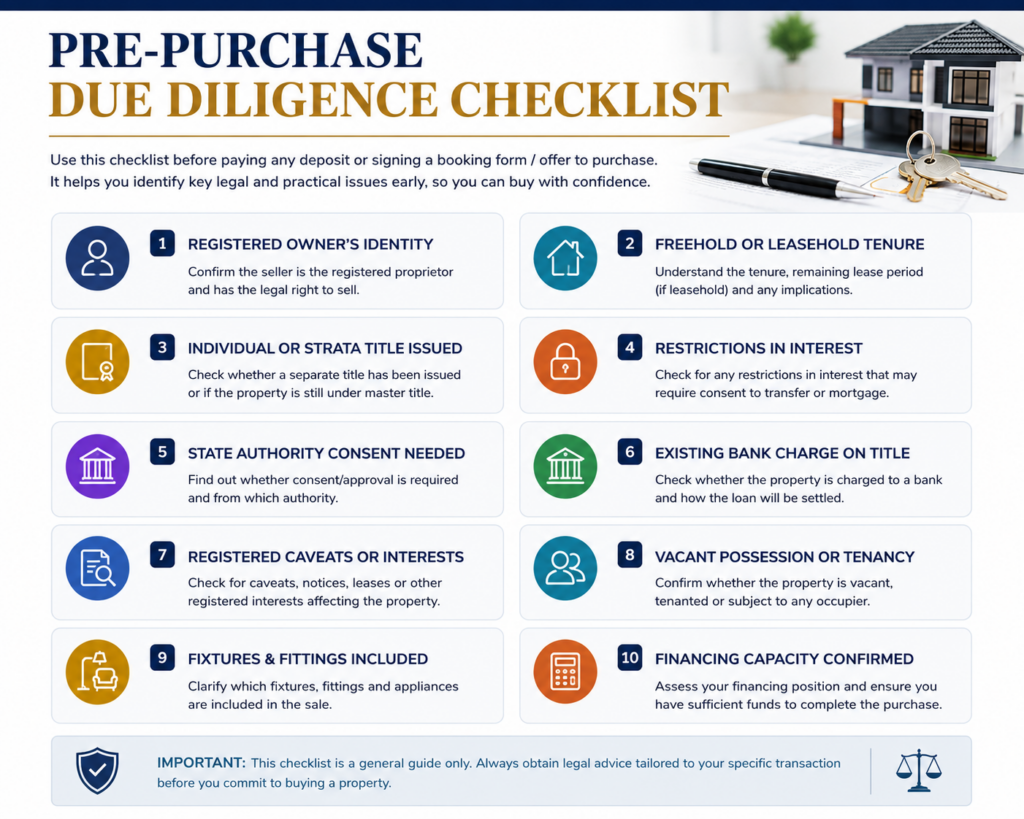
1. What Should I Check Before Buying a Property in Malaysia?
Before committing to buying property in Malaysia, establish the basic legal and financial position of the property, establish the basic legal and financial position of the property.
At a minimum, a purchaser should know:
- the actual purchase price;
- the identity of the registered owner;
- whether the property is freehold or leasehold;
- whether an individual or strata title has been issued;
- whether there is any restriction in interest;
- whether State Authority consent is required;
- whether the property is charged to a bank;
- whether there are registered caveats or other interests;
- whether the property will be delivered vacant or subject to an existing tenancy;
- what fixtures and fittings are included; and
- whether the purchaser has sufficient financing to complete the transaction.
Do not assume that every legal problem can be solved after signing the SPA.
Some problems can be dealt with contractually.
Others may affect whether the transaction should proceed at all.
The safest time to identify a property problem is before you become contractually bound.
PART 2 — THE BOOKING FORM AND EARNEST DEPOSIT
2. Should I Pay a Booking Fee Before Appointing a Lawyer?
Purchasers frequently pay an earnest deposit or booking deposit when signing an offer to purchase or booking form.
This is commonly done through an estate agent.
However, the fact that a document is called a “booking form”, “offer to purchase” or “letter of offer” does not necessarily mean that it has no legal consequences.
Before signing or paying money, understand:
- how much is being paid;
- who will hold the money;
- whether it forms part of the purchase price;
- when it becomes non-refundable;
- the deadline for signing the SPA;
- whether the purchase is subject to financing;
- what happens if financing is rejected;
- what happens if a legal problem with the property is discovered;
- whether any consent or approval is required; and
- what happens if the transaction cannot proceed.
A purchaser should be particularly cautious about paying a non-refundable deposit before important legal issues have been identified.
3. Is a 10% Deposit Compulsory?
A 10% deposit is common in Malaysian subsale transactions, but purchasers should not confuse common conveyancing practice with an absolute rule applicable to every transaction.
The amount of the contractual deposit ultimately depends upon the terms agreed between the parties.
Frequently, an earnest deposit is paid when the offer to purchase is signed, with the balance of the agreed deposit paid upon signing the SPA.
For example, if a purchaser has already paid 3% as an earnest deposit and the agreed contractual deposit is 10%, the remaining 7% may be payable upon execution of the SPA.
However, the actual payment structure must be determined from the documents governing the particular transaction.
PART 3 — APPOINTING A CONVEYANCING LAWYER
4. When Should I Appoint a Lawyer?
Ideally, before you become legally committed to the purchase.
Your conveyancing lawyer can investigate the legal position of the property, advise on the transaction and prepare or review the SPA. For a completed property, a subsale conveyancing lawyer can also guide the purchaser through the SPA, financing, redemption and transfer process from start to completion.
Where you have already signed a booking form or offer to purchase, provide it to your lawyer immediately.
Do not wait until the SPA is ready for signing.
By then, some important commercial terms may already have been agreed.
5. What Does a Conveyancing Lawyer Actually Do?
Depending upon the transaction, the purchaser’s lawyer may:
- conduct title and other relevant searches;
- verify ownership;
- examine restrictions in interest;
- identify charges and caveats;
- advise on consent requirements;
- prepare or review the SPA;
- negotiate legal terms with the seller’s solicitors;
- prepare transfer or assignment documentation;
- coordinate with the purchaser’s financier and loan solicitors;
- deal with the seller’s redemption arrangements;
- arrange stamping of relevant instruments;
- handle completion payments;
- arrange registration of the transfer;
- calculate relevant apportionments; and
- attend to post-completion matters.
The lawyer’s role is not merely to prepare paperwork.
A properly conducted conveyancing transaction is fundamentally about identifying legal risks and ensuring that title, money and contractual obligations move in the correct sequence.
PART 4 — CHECKING THE TITLE
6. Why Is a Land Search Important?
A land search is one of the most important early steps in buying property in Malaysia, and can reveal important information concerning the property.
Depending upon the title and circumstances, this may include:
- the registered proprietor;
- title particulars;
- tenure;
- category of land use;
- express conditions;
- restrictions in interest;
- registered charges;
- private caveats; and
- other registered interests or endorsements.
The purchaser should not simply assume that the person selling the property has an unrestricted ability to transfer it.
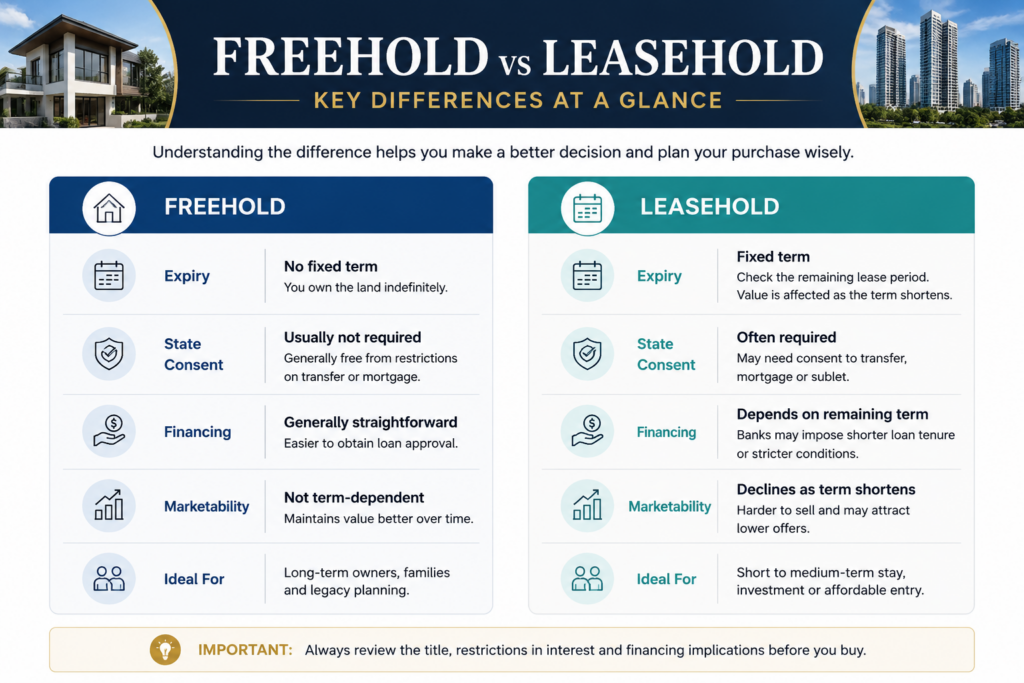
7. What Is the Difference Between Freehold and Leasehold Property?
A freehold title generally does not have the fixed expiry date associated with a leasehold title.
A leasehold title is granted for a specified term.
Purchasers of leasehold property should therefore consider:
- the remaining lease period;
- whether a restriction in interest applies;
- whether State Authority consent is required;
- financing implications; and
- the property’s future marketability.
A leasehold property is not automatically a bad purchase.
However, its title position should be properly understood before the purchaser commits.
8. What Is a Restriction in Interest?
A restriction in interest (“sekatan kepentingan“) is a condition endorsed on the title by the State Authority that limits what the registered owner can do with the property — commonly restricting transfer, charge (mortgage), lease, or transfer to non-citizens without prior State Authority consent.
Where a restriction in interest applies, the purchaser cannot simply proceed to transfer as usual. An application for consent must first be made to the relevant State Authority, and the transaction may be structured as conditional upon that consent being granted.
A purchaser should check the title early for any restriction in interest, since it directly affects the completion timeline and the documents required.
9. What If the Individual or Strata Title Has Not Been Issued?
Not every Malaysian property transaction involves an already-issued separate title.
Where the individual or strata title has not yet been issued, the purchaser’s interest may instead be dealt with through assignment documentation and the relevant chain of contractual documents.
This can affect:
- the documents required;
- the transfer mechanism;
- financing documentation;
- developer or proprietor confirmation;
- consent requirements;
- completion procedures; and
- what must subsequently happen when the separate title is issued.
This is also why purchasers should keep their original SPA, assignment documents, loan documents and other important property records safely even after completion.
They may be required years later.
10. What Is the SPA?
The Sale and Purchase Agreement is the principal contract governing the sale.
For a subsale property, the SPA commonly deals with matters including:
- purchase price;
- deposit;
- completion period;
- late-payment interest;
- title and property particulars;
- existing encumbrances;
- redemption of the seller’s financing;
- consent requirements;
- vacant possession;
- existing tenancy, where applicable;
- fixtures and fittings;
- apportionment of outgoings;
- representations and warranties;
- purchaser default;
- seller default; and
- termination and remedies.
A purchaser should understand the SPA before signing it, not after a problem occurs.
11. Is Every Malaysian Subsale SPA the Same?
No.
There are common conveyancing practices and commonly encountered provisions, but a subsale SPA is ultimately a contractual document that should reflect the particular transaction.
A straightforward condominium purchase by a Malaysian citizen with an issued strata title may require different provisions from:
- a leasehold property requiring State consent;
- a property without separate title;
- a tenanted property;
- a foreign purchaser transaction;
- a property subject to substantial bank redemption;
- an estate sale;
- a property involving a power of attorney; or
- a transaction subject to particular conditions precedent.
This is one reason why copying an SPA from an unrelated transaction can be dangerous.
PART 7 — COMPLETION PERIOD
12. How Long Does a Subsale Property Transaction Take?
When buying property in Malaysia, there is no fixed statutory completion period — it depends on the SPA. A straightforward transaction (issued title, no consent needed, no complex redemption) commonly completes within 3 months of signing.
Timelines extend where the transaction involves State Authority consent, a complex bank redemption, an estate sale, a foreign purchaser, or other conditions precedent — since the completion clock in the SPA may only start running once those conditions are satisfied, not from the signing date itself.
Always check what the SPA actually defines as the start of the completion period, rather than assuming “3 months from signing” applies automatically.
PART 8 — FINANCING THE PURCHASE
13. Should I Obtain Loan Approval Before Signing the SPA?
Where bank financing is essential to the purchase, the purchaser should address financing as early as possible.
A verbal indication from a banker or mortgage consultant is not the same as an unconditional loan approval.
Purchasers should consider:
- the approved loan amount;
- financing margin;
- property valuation;
- loan conditions;
- their required cash contribution;
- legal and valuation costs; and
- whether sufficient funds remain available for stamp duty and other acquisition expenses.
If the bank values the property below the purchase price, the purchaser may have to contribute substantially more cash than originally anticipated.
14. What Happens If My Housing Loan Is Rejected?
It depends upon your contract.
There is no automatic rule that a purchaser may cancel a property purchase without consequence merely because a bank rejects the loan.
If the SPA or other binding agreement is not conditional upon obtaining financing, loan rejection may not excuse the purchaser’s obligation to complete.
Where financing is essential, consider before committing whether an appropriate financing condition can be negotiated.
For example, the parties may agree upon circumstances in which an earnest deposit is refundable if genuine financing applications are rejected.
Whether such protection exists depends on the contractual terms.
Do not assume “loan rejected” automatically means “deposit refunded”.
PART 9 — SELLER'S EXISTING BANK LOAN
15. What Happens If the Property Is Still Charged to the Seller's Bank?
This is extremely common.
The seller’s existing financing generally needs to be redeemed so that the existing bank’s security can be discharged or released and the property can ultimately be transferred or assigned appropriately.
The conveyancing lawyers coordinate the redemption process.
This commonly involves:
- obtaining the redemption statement;
- establishing the amount required by the seller’s financier;
- arranging payment in accordance with the SPA and financing documentation;
- obtaining the relevant discharge/reassignment documentation; and
- proceeding with the transfer or assignment mechanism.
The precise process differs depending upon whether the property has an issued title and the form of security held by the bank.
16. What If the Seller Owes the Bank More Than the Purchase Price?
This is a serious issue that should be identified early.
If the redemption sum exceeds the amount available from the sale proceeds, the seller may need to provide the shortfall before the existing financier will release its security.
The SPA should appropriately address the redemption mechanism and the parties’ obligations. For instance, the deposit may be held by the seller’s solicitors as stakeholder for payment of the shortfall redemption sum.
A purchaser should not assume that every existing bank loan can automatically be redeemed from the purchase price.
PART 10 — STAMP DUTY AND OTHER PURCHASE COSTS
17. What Costs Should a Property Buyer Budget For?
Budgeting correctly is one of the most overlooked parts of buying property in Malaysia. Depending upon the transaction, a purchaser may need to budget for:
- the purchase deposit;
- SPA legal fees;
- transfer stamp duty;
- loan legal fees;
- loan stamp duty;
- valuation fees;
- registration fees;
- consent fees;
- search fees;
- disbursements;
- maintenance and sinking-fund contributions;
- insurance;
- renovation; and
- other property-specific costs.
The monthly mortgage instalment is therefore only one component of the true cost of acquiring a property.
Check out our stamp duty and legal fees calculator here.
18. Do I Pay Stamp Duty Based on the Purchase Price?
Transfer stamp duty is generally assessed by reference to the consideration or the relevant adjudicated market value, whichever basis is applicable/higher under the prevailing law.
A purchaser should therefore not assume that purchasing a property at a discounted price necessarily means that stamp duty will be assessed only on that lower figure.
The applicable legislation and current stamping practice should always be checked for the particular transaction.
Read more about stamp duty on transfer here.
19. Do I Need to Pay for Stamp Duty on the Housing Loan
If financing is obtained, stamp duty is also generally payable on the principal loan/security instrument.
This is separate from the stamp duty payable on the transfer.
Therefore, a financed purchaser should budget for both the purchase side and financing side of the transaction.
20. What is the First-Time Home Buyer Incentives
Tax and stamp-duty incentives change over time.
As at 2026, qualifying first-home purchasers should check whether they fall within the prevailing first-home stamp-duty exemption regime.
LHDN has confirmed the continuation of the applicable first-home exemption of stamp duty on transfer and loan documents conditions under the new orders, including the relevant RM500,000 threshold and qualifying criteria.
The conditions must be checked carefully; the relief is not available simply because a person describes himself or herself as a “first-time buyer”.
PART 11 — STATE AUTHORITY CONSENT
21. When Is State Authority Consent Required?
State Authority consent may be required in various circumstances, including where a restriction in interest or applicable State rule requires approval for the proposed dealing.
The exact requirements vary between States.
Malaysia’s land system is State-based. A rule applicable in Penang should not automatically be assumed to apply identically in Selangor, Johor, Kuala Lumpur or another State.
The title, purchaser’s status, property type and applicable State requirements must therefore be examined.
22. How Does State Consent Affect the Completion Period?
Where State Authority consent or another approval is required, the SPA should address:
- who must make the application;
- the time allowed for submission;
- what documents must be provided;
- whether an appeal is required if the first application is rejected;
- what happens if approval is ultimately refused; and
- when the contractual completion period begins.
In practice, an SPA requiring State Authority consent may make the transaction conditional upon the relevant consent being obtained.
The ordinary completion period—for example, three months—may therefore begin only after the stipulated condition precedent has been fulfilled, depending upon the SPA.
Do not calculate your completion deadline simply by counting three months from the SPA date.
The contractual definition of the completion period must be checked.
PART 12 — BUYING PROPERTY IN MALAYSIA AS A FOREIGNER
23. Can Foreigners Buy Property in Malaysia?
Foreigners buying property in Malaysia generally can, subject to restrictions and applicable approvals.
Foreign purchasers should consider:
- State minimum purchase-price requirements;
- State Authority consent;
- prohibited or restricted categories of property;
- Malay Reservation restrictions;
- Bumiputera-related restrictions where applicable;
- property type;
- MM2H requirements, if relevant;
- financing;
- stamp duty; and
- additional acquisition costs.
Foreign ownership rules vary between States and can change.
There is therefore no single foreign-property rule that should be assumed to apply throughout Malaysia.
A foreign purchaser should obtain State-specific advice before paying a non-refundable deposit.
Further reading: Foreign purchasers considering Penang property can refer to our detailed guide on Foreigners, MM2H Participants and Permanent Residents Buying Property in Penang and
24. What Stamp Duty Applies to Foreign Purchasers From 2026?
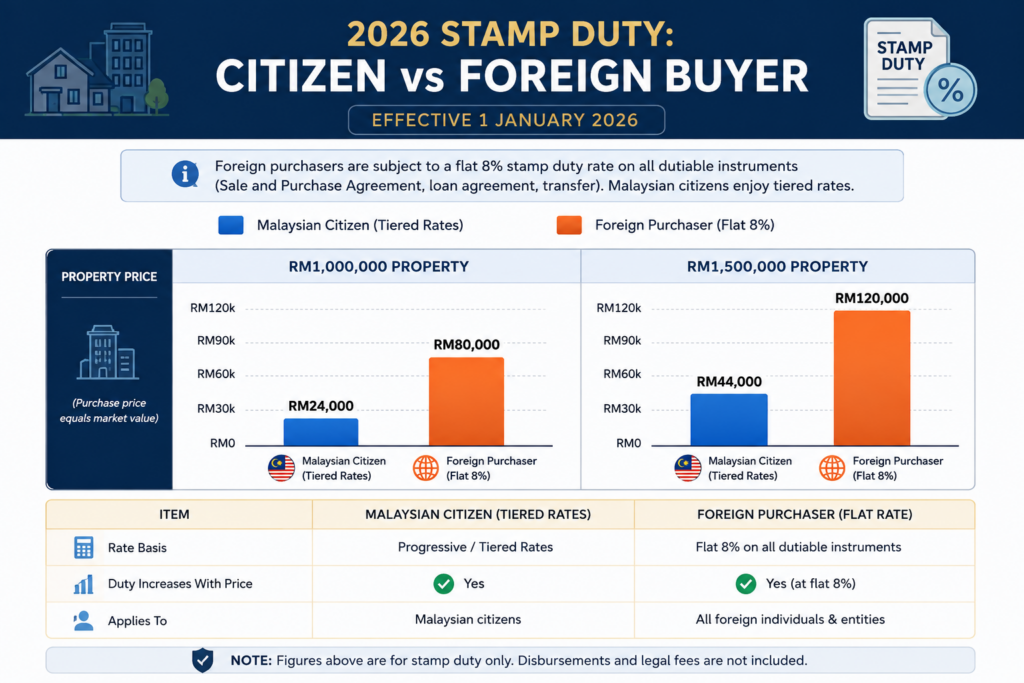
From 1 January 2026, an important stamp-duty change affects certain acquisitions of residential property by foreign purchasers.
Broadly, the applicable flat stamp-duty rate for transfers of residential property to specified non-citizen purchasers and foreign companies increased to 8%, subject to the applicable legislation and circumstances of the particular transaction.
This can represent a substantial acquisition cost.
For example, 8% of RM2 million is RM160,000.
Foreign purchasers should therefore obtain a proper acquisition-cost calculation before committing to the property.
The treatment of residential and non-residential property may differ, and purchasers should establish the property’s legal classification rather than relying solely upon its marketing description.
Further reading: See our Complete Guide to Foreigner Stamp Duty in Malaysia (2026) for a detailed explanation of the applicable rates and different transaction structures.
PART 13 — BUYING A CONDOMINIUM OR STRATA PROPERTY
25. What Else Should a Condo Buyer Check?
For a strata property, do not inspect only the unit.
You are effectively buying into a larger development and its management structure.
Where information is available, consider:
- strata-title status;
- maintenance charges;
- sinking fund;
- outstanding management charges;
- special levies;
- JMB or management corporation issues;
- house rules;
- car-park rights;
- accessory parcels;
- renovation restrictions;
- short-term rental restrictions;
- major defects affecting common property;
- significant anticipated expenditure; and
- ongoing disputes affecting the development.
A beautifully renovated unit inside a financially troubled or poorly managed development may not be a good acquisition.
A good unit does not necessarily mean a good development.
PART 14 — BUYING A TENANTED PROPERTY
26. What If There Is Already a Tenant?
First establish whether the property is being purchased:
With vacant possession
The seller must deliver the property free of occupants in accordance with the SPA.
or
Subject to the existing tenancy
The purchaser takes over the property subject to the agreed tenancy arrangements.
If purchasing subject to tenancy, review:
- the tenancy agreement;
- rental amount;
- tenancy expiry date;
- security and utility deposits;
- rental arrears;
- renewal options;
- termination provisions;
- outstanding obligations; and
- whether the tenant has complied with the tenancy.
Do not rely only on the seller or agent saying:
“The tenant is good.”
Read the tenancy agreement.
27. What Happens to the Tenancy When the Property Is Sold?
Where the sale is expressly subject to an existing tenancy, the contractual documentation should address the transition from the seller as existing landlord to the purchaser as the new owner.
Depending upon the arrangement, the lawyers may need to prepare appropriate documentation dealing with the transfer or novation of the landlord’s rights and obligations.
Relevant matters can include:
- when the purchaser assumes the landlord’s position;
- transfer of security and utility deposits;
- rental collected before and after completion;
- outstanding rental;
- continuing obligations under the tenancy; and
- notification to the tenant.
Where a novation or other instrument is used, the applicable stamping requirements should also be considered.
PART 15 — INSPECT THE PROPERTY
28. Does the Lawyer Check the Physical Condition of the Property?
Ordinarily, no.
Your conveyancing lawyer primarily handles the legal transaction, not the structural or physical condition of the building.
A title search cannot tell you whether the roof leaks.
An SPA cannot tell you whether termites have damaged the cabinets.
For a subsale property, purchasers should personally inspect the property and, where appropriate, engage qualified professionals.
Look for matters such as:
- water leakage;
- cracks;
- roof problems;
- illegal extensions;
- renovation approvals;
- electrical condition;
- plumbing;
- termites;
- boundaries;
- encroachments;
- air-conditioners;
- built-in cabinets;
- fixtures; and
- other items represented as included in the sale.
29. Should I Take Photographs Before Buying?
Yes.
If particular fixtures, furniture, appliances or the property’s condition form an important part of the bargain, do not rely solely upon memory or verbal representations.
Where appropriate, important items should be identified in the contractual documentation or an agreed inventory.
Photographs or videos taken before signing and again before vacant possession can also provide useful evidence of:
- the property’s condition;
- fixtures and fittings;
- furniture represented as included; and
- other relevant physical matters.
Legal due diligence and physical due diligence are different. A purchaser needs both.
PART 16 — VACANT POSSESSION AND COMPLETION
30. When Do I Get the Keys?
For a subsale transaction, the purchaser does not automatically receive the keys immediately after signing the SPA.
Vacant possession is delivered according to the terms of the SPA.
Depending upon the contractual provisions, this commonly occurs after the purchase price has been fully paid or deemed paid and the agreed completion requirements have been satisfied.
The exact contractual trigger matters.
The SPA should clearly address:
- when vacant possession must be delivered;
- whether the property must be vacant;
- whether fixtures and fittings must remain;
- whether keys and access cards are included;
- whether an inspection is permitted before possession;
- how outgoings are apportioned; and
- what happens if the seller fails to deliver possession.
Further reading: See our detailed article on Vacant Possession in Malaysian Subsale Property Transactions.
31. Should I Inspect the Property Before Taking Vacant Possession?
Where the SPA permits or provides for a pre-handover inspection, the purchaser should take the opportunity to inspect the property.
Check that:
- the property is in the expected condition;
- agreed fixtures and fittings remain;
- occupants have vacated where vacant possession is required;
- keys and access cards are available; and
- material issues are raised promptly.
Do not wait several months after taking possession before raising an issue that could have been identified during handover.
32. What Outgoings Are Usually Apportioned?
Depending upon the property and SPA, adjustments may include:
- quit rent;
- assessment;
- maintenance charges;
- sinking fund;
- sewerage charges;
- rental; and
- other agreed outgoings.
Typically, the seller bears the relevant expenses up to the agreed contractual completion or possession date and the purchaser bears them thereafter, subject to the SPA.
The parties’ lawyers calculate the appropriate apportionment during completion.
PART 17 — AFTER YOU GET THE KEYS
33. Is the Transaction Finished Once I Receive the Keys?
Not necessarily.
Post-completion matters may still include:
- updating management records;
- updating assessment ownership records;
- changing utility accounts;
- taking over tenancy deposits where applicable;
- retaining important completion documents; and
- dealing with outstanding registration or title matters.
The sequence varies depending upon the transaction.
Keep your SPA, stamped transfer or assignment documents, loan documents, receipts and other important property records safely.
You may need them many years later when selling, refinancing or otherwise dealing with the property
PART 18 — WHAT IS PERFECTION OF TRANSFER?
34. I Bought the Property Years Ago. Why Do I Need Another Transfer?
This frequently occurs where a purchaser originally bought a property before the individual or strata title was issued.
At the time of the original purchase, the purchaser’s interest may have been transferred by assignment rather than by registration against a separate title.
When the individual or strata title is subsequently issued, the purchaser may need to complete a Perfection of Transfer (POT) so that legal ownership is registered against the newly issued title.
If the property remains financed, a Perfection of Charge (POC) may also be required in favour of the bank.
Do not ignore correspondence informing you that your strata or individual title has been issued.
Delaying perfection can create unnecessary complications when you later wish to sell or refinance the property.
Further reading: Read our Complete Guide to Perfection of Transfer and Perfection of Charge in Malaysia.
PART 19 — COMMON MISTAKES WHEN BUYING PROPERTY IN MALAYSIA
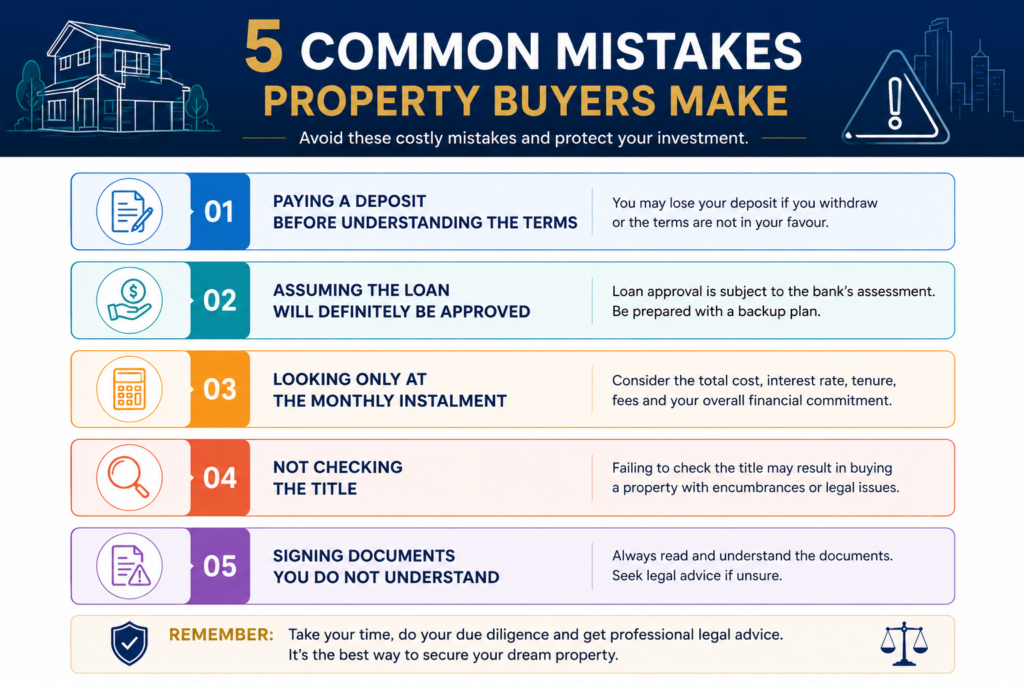
35. Paying a Deposit Before Understanding the Terms
When buying property in Malaysia, it’s easy to make avoidable mistakes. A purchaser sees the perfect property and wants to “secure it” immediately.
That urgency can be expensive.
Before paying an earnest deposit, understand:
- what you are signing;
- when the deposit becomes forfeitable;
- what happens if financing fails;
- what happens if legal problems are discovered; and
- whether the purchase is subject to necessary approvals.
Do not assume a booking form has no consequences merely because the SPA has not yet been signed.
36. Assuming the Loan Will Definitely Be Approved
A verbal statement from a banker or agent is not the same as unconditional loan approval.
Know how you will complete the purchase if:
- financing is rejected;
- the approved margin is lower than expected;
- the valuation is lower than the purchase price; or
- loan disbursement is delayed.
Where financing is essential, consider whether an appropriate financing condition should be negotiated before committing yourself.
37. Looking Only at the Monthly Instalment
A property purchase involves much more than a mortgage instalment.
Calculate:
Deposit + legal fees + stamp duty + loan costs + valuation + renovation + maintenance + sinking fund + insurance + taxes + emergency reserve.
Affordability is not merely whether a bank is willing to lend you money.
It is whether you can comfortably acquire, finance and maintain the property.
38. Not Checking the Title
A property may look perfectly normal while its title reveals issues that materially affect the transaction.
These can include:
- restrictions in interest;
- charges;
- caveats;
- title conditions;
- ownership issues; or
- consent requirements.
The title search is therefore a fundamental part of legal due diligence.
39. Assuming the Agent or Seller's Description Is Legally Conclusive
Statements such as:
“Freehold.”
“No consent needed.”
“The car park belongs to the unit.”
“You can Airbnb this.”
“The extension is approved.”
should not automatically be treated as established legal facts.
Where the matter is material to your decision, verify it through the appropriate documents and professional enquiries.
40. Signing Documents You Do Not Understand
Do not sign merely because someone says:
“This is standard.”
A clause can be commonly used and still have serious consequences for you.
If you do not understand a provision, ask before signing.
PART 20 — CHECKLIST FOR BUYING PROPERTY IN MALAYSIA
41. Before Paying an Earnest Deposit or Booking Deposit
Use this checklist at each stage of buying property in Malaysia:
☐ Confirm the actual purchase price.
☐ Check your financing capacity.
☐ Understand whether the earnest deposit is refundable especially when loan is rejected or terms cannot be agreed.
☐ Identify the registered owner.
☐ Ask whether the property is freehold or leasehold.
☐ Ask whether an individual or strata title has been issued.
☐ Check whether State consent is required.
☐ Ask whether the property is charged to a bank.
☐ Ask whether there are caveats.
☐ Confirm whether the property is vacant or tenanted.
☐ Identify fixtures and fittings included in the sale.
☐ Understand the SPA signing deadline (whether you can make it in time)
☐ Inspect and understand the physical condition of the property.
☐ Take photographs or videos of important conditions and items where appropriate.
☐ Obtain legal advice if anything appears unusual.
42. Before Signing the SPA
☐ Ensure the title and relevant searches have been reviewed.
☐ Understand the completion period and when it begins.
☐ Understand late-payment interest.
☐ Confirm your financing position.
☐ Check the redemption mechanism.
☐ Check consent requirements.
☐ Confirm vacant-possession terms.
☐ Confirm fixtures and fittings.
☐ Review the existing tenancy, if applicable.
☐ Understand what constitutes purchaser default.
☐ Understand what constitutes seller default.
☐ Know what happens to your deposit if the transaction cannot proceed.
43. Before Completion
☐ Sign loan documentation promptly.
☐ Prepare your own cash contribution.
☐ Prepare for stamp duty and other transaction costs.
☐ Respond promptly to requests for documents.
☐ Arrange any required EPF withdrawal early.
☐ Prepare for the handover and inspection of the property.
☐ Keep sufficient funds available for adjustments and other completion expenses.
PART 21 — FREQUENTLY ASKED QUESTIONS
How Long Does Buying Property in Malaysia Take?
There is no universal period.
A straightforward transaction may commonly use a three-month contractual completion period, sometimes with an extension subject to interest.
However, transactions requiring State consent, redemption, probate, court orders, foreign purchaser approval or other conditions may take longer.
The commencement of the contractual completion period is also important. Where the SPA contains conditions precedent, the completion period may begin only after the relevant condition has been fulfilled.
Always rely upon the actual SPA rather than a general estimate.
Is a 10% Deposit Compulsory?
A 10% deposit is common in Malaysian subsale practice, but the contractual deposit ultimately depends upon what the parties agree.
Do not confuse common practice with an absolute legal rule.
Can I Cancel After Signing the SPA?
Possibly, but there may be serious contractual consequences.
A purchaser cannot ordinarily treat a signed SPA as merely a reservation form.
Depending upon the contract and circumstances, withdrawal may result in forfeiture of the deposit and potentially other contractual remedies.
Seek legal advice immediately if you are considering withdrawing from a signed transaction.
What Happens If My Bank Loan Is Rejected?
It depends upon your contract.
If the transaction is not conditional upon obtaining financing, rejection of the purchaser’s loan may not excuse the purchaser’s obligation to complete.
This is why financing should be addressed before committing yourself.
Can I Use EPF to Buy Property?
Eligible EPF members may make housing-related withdrawals subject to EPF’s prevailing requirements.
Check your eligibility and required documentation early and inform your conveyancing lawyer that you intend to make an EPF withdrawal.
Your lawyer can assist with the relevant transaction documents required for the application, where applicable.
Do not assume that an EPF application automatically extends a contractual payment deadline.
For current eligibility, documentation and withdrawal procedures, refer to the official Employees Provident Fund (KWSP) guidance.
Can Foreigners Buy Property in Malaysia?
Generally yes, subject to State rules, minimum purchase-price thresholds, property restrictions, State Authority consent and applicable Federal requirements.
The requirements are State-specific.
A foreign purchaser should therefore obtain advice concerning the particular State and property before paying a non-refundable deposit.
Who Pays RPGT — Buyer or Seller?
Real Property Gains Tax (“RPGT”) is principally a tax arising from the seller/disposer’s chargeable gain.
A purchaser should not assume RPGT is irrelevant just because they are not the seller — it can still affect buying property in Malaysia.
The purchaser/acquirer also has important statutory reporting and retention/remittance obligations under the RPGT legislation.
Accordingly, a purchaser should not assume that RPGT is entirely irrelevant merely because the tax is principally imposed upon the disposer.
Do I Pay Stamp Duty Based on the Purchase Price?
Transfer stamp duty is generally assessed by reference to the consideration or relevant adjudicated market value in accordance with the applicable legislation.
A low purchase price does not necessarily mean that LHDN will assess duty only on that figure.
What Documents Should I Give My Conveyancing Lawyer?
Depending upon the transaction, commonly requested documents and information include:
- NRIC or passport;
- correspondence address;
- contact details;
- offer to purchase or booking form;
- proof of deposit;
- bank loan information or Letter of Offer;
- property details;
- estate-agent details;
- documents supplied by the seller or agent; and
- any other document concerning the purchase that you do not understand or are unsure about.
Your lawyer may request additional documents depending upon the transaction.
It is generally better to give your conveyancing lawyer relevant information at the beginning than to disclose an important document after the SPA has already been signed.
FINAL ADVICE FROM A CONVEYANCING LAWYER
The Best Time to Solve a Property Problem Is Before You Become Contractually Bound
After helping clients with buying property in Malaysia for many years, one lesson remains remarkably consistent:
Most serious conveyancing problems are cheaper to prevent than to cure.
Purchasers understandably focus on:
- Location.
- Price.
- Renovation.
- Financing.
- Investment potential.
A conveyancing lawyer looks at a different set of questions:
- Does the seller have good title?
- Can the property legally be transferred to you?
- What restrictions affect the property?
- Is any consent or approval required?
- What must happen before your money is released?
- Can the seller redeem and discharge the existing financing?
- What happens if the seller cannot complete?
- What happens if your financing is insufficient?
- When does the completion period actually begin?
- What exactly must be handed over when you receive possession?
These questions may appear less exciting when you have just found the property you want to buy.
But they are often the questions that prevent a straightforward property purchase from becoming an expensive dispute.
The Most Important Advice in This Guide
Do not wait until after signing the SPA to discover what you have agreed to.
A conveyancing lawyer is most useful before the problem arises—when the transaction can still be investigated, structured and documented appropriately.
Once money has been paid, contractual obligations have arisen and deadlines have started running, the available solutions may become considerably narrower.
That is the practical difference between merely processing a property transaction and properly advising a property purchaser.
Written by
Doreen Lim
Partner, C K Lim & Partners
OTHER RELATED ARTICLES
- RPGT in Malaysia (2026): Rates, Exemptions and Selling Inherited Property
- Perfection of Transfer (POT) & Perfection of Charge (POC) in Malaysia: A Complete Guide for Property Owners
- Foreigner Stamp Duty in Malaysia (2026): Everything Foreign Buyers Need to Know Before Buying Property
- Can Foreigners, MM2H Holders and Permanent Residents Buy Property in Penang? Penang Controlled Pricing Explained
- Vacant Possession in Malaysia: What Property Purchasers Must Check Before and After Completion (Including “As Is Where Is” Explained)
- Subsale Conveyancing FAQ in Penang
- Foreign Buyer Stamp Duty Doubled to 8% in 2026 — What Changed
- Conveyancing Tip: Why Perfection of Transfer (POT) Is Crucial in Malaysia
- Understanding Stamp Duty for Property Purchases and Transfers in Malaysia
- A Guide to Conveyancing in Malaysia
- First time homebuyers things you need to know
DISCLAIMER
The information contained in this article is provided for general informational and educational purposes only and does not constitute legal, tax, financial or professional advice. Whilst every effort has been made to ensure that the information is accurate and up to date as at the date of publication, the law, governmental policies and administrative practices may change from time to time.
The application of the law depends on the specific facts and circumstances of each transaction. Accordingly, readers should not rely on this article as a substitute for obtaining independent legal advice. Before making any decision relating to the purchase, sale or transfer of property in Malaysia, you should consult a qualified legal practitioner to obtain advice tailored to your particular circumstances.
C K LIM & PARTNERS accepts no responsibility or liability for any loss or damage arising from any reliance placed on the information contained in this article without first obtaining appropriate legal advice.
If you require advice on Perfection of Transfer, Perfection of Charge, the sale or refinancing of a property with an outstanding perfection process, or any related conveyancing matter, our team would be pleased to advise you based on the particular facts and documents involved.
Every property transaction is different.
The appropriate conveyancing structure depends upon matters such as the title, financing, existing charge, purchaser’s status, State consent requirements, tenancy arrangements and other circumstances affecting the property.
C K LIM & PARTNERS advises purchasers on Malaysian property transactions, including subsale conveyancing, financing, foreign property purchases, State Authority consent and related property matters.
If you are considering purchasing a property, obtaining advice before signing binding documents or paying a non-refundable deposit can prevent considerably more difficult problems later.