
RPGT in Malaysia (2026): Rates, Exemptions and Selling Inherited Property
RPGT in Malaysia (2026): Rates, Exemptions and Selling Inherited Property
About the Author
This guide is written by Doreen Lim Wan Tse, Advocate & Solicitor of the High Court of Malaya and Partner of C K Lim & Partners, with more than 15 years of experience in Malaysian conveyancing, property transfers, refinancing, estate administration and probate matters. The firm has acted for thousands of Malaysian property transactions and regularly advises sellers on RPGT matters.
Real Property Gains Tax (RPGT), or Cukai Keuntungan Harta Tanah (CKHT), is a tax on the chargeable gain when you dispose of real property in Malaysia, not on the selling price. For an individual who is a Malaysian citizen or permanent resident, RPGT in Malaysia is 30% if you sell within the first three years, 20% in the 4th year, 15% in the 5th year, and nil from the 6th year. Foreign individuals pay 30% for the first five years and 10% from the 6th year. Since 1 January 2025 the seller must calculate the tax and file Form CKHT 1A through e-CKHT within 60 days of the disposal date, and pay any balance within 90 days.
Selling a property in Malaysia involves more than agreeing on the price and signing a Sale and Purchase Agreement (“SPA”).
One of the matters a seller should understand before completing the sale is Real Property Gains Tax (“RPGT”), or Cukai Keuntungan Harta Tanah (“CKHT”). This becomes particularly important where:
- you bought the property only a few years ago;
- the property has increased substantially in value;
- you inherited the property from a deceased family member;
- several beneficiaries inherited the same property and now wish to sell it;
- you are transferring property between family members;
- you are a foreign property owner;
- the registered owner has passed away; or
- you want to know how much money you will actually receive from the sale.
A common misunderstanding is that RPGT is calculated simply by applying the tax rate to the selling price. It is not. The computation starts with the statutory disposal price and acquisition price before allowable expenditure, exemptions and losses are considered.
Scope note. This guide covers real property such as houses, commercial buildings, farms and vacant land. Shares in real property companies are treated differently; since 1 January 2024, certain disposers (companies, limited liability partnerships, trust bodies and co-operatives) are taxed on those shares under Capital Gains Tax rather than RPGT. Also, RPGT in Malaysia only catches gains that are not already chargeable to income tax, so a developer or property trader selling stock in trade is generally taxed under the Income Tax Act instead.
1. What are the current RPGT rates in Malaysia?
The rate depends on who the disposer is and how long the property has been held. HASiL groups disposers into three categories under Schedule 5 of the Real Property Gains Tax Act 1976. The rates below apply to disposals from 1 January 2022.
Holding period | Part I | Part II | Part III |
Years 1–3 (within 2 years and the 3rd year) | 30% | 30% | 30% |
4th year | 20% | 20% | 30% |
5th year | 15% | 15% | 30% |
6th year onwards | Nil | 10% | 10% |
Part I is any disposer who is not in Part II or III. HASiL’s examples are Malaysian citizens and partnerships. Because Part III only covers people who are neither citizens nor permanent residents, an individual permanent resident also falls in Part I.
Part II covers companies incorporated in Malaysia, trustees of a trust, and bodies of persons registered under Malaysian written law.
Part III covers individuals who are neither citizens nor permanent residents, the executor of the estate of a deceased person who was neither a citizen nor a permanent resident, and companies not incorporated in Malaysia. A long-term residence pass such as MM2H should not be assumed to amount to Malaysian permanent-resident status for RPGT purposes. An individual who is neither a Malaysian citizen nor a permanent resident falls within Part III.
Do I have to pay RPGT if I sell after 5 years?
If you are a Part I disposer (for example a Malaysian citizen or permanent resident individual), the RPGT rate from the 6th year onwards is nil. For Part II and Part III disposers, the rate from the 6th year is 10%. So the right question is not just “have I owned it for more than five years?” but “which category am I in, what is my statutory acquisition date and what is my statutory disposal date?”
Intend to sell a Property?
Planning to sell a property?
Before accepting an offer, it is useful to establish your RPGT category, statutory acquisition date, estimated chargeable gain and the section 21B amount that may be retained from the sale consideration.
Contact C K Lim & Partners for assistance.
2. How is the holding period for RPGT determined?
Do not simply count from the date you received the keys, moved in or registered the title. HASiL states that where there is a written agreement, the disposal date is the date of the agreement. If there is no written agreement, it is the date the disposal is completed, meaning the earlier of the date ownership is transferred and the date the whole consideration is received. The buyer’s acquisition date is deemed to be the same as the seller’s disposal date.
A difference of even a few weeks can move a sale into a different holding-period band, and therefore a different rate.
3. How is RPGT calculated?
HASiL’s computation works in these steps:
Disposal price = the consideration for the disposal, less allowable expenses (enhancement or preservation expenditure reflected in the property at disposal, expenditure to establish, preserve or defend title, and the incidental costs of disposal).
Acquisition price = the consideration paid for the property plus the incidental costs of acquisition, less any compensation for damage or depreciation, insurance sums received, and any deposit forfeited to the disposer.
Gain = disposal price less acquisition price. If the disposal price is lower, there is an allowable loss.
For an individual,
a) deduct the paragraph 2, Schedule 4 exemption: RM10,000 or 10% of the gain, whichever is greater.
b) Deduct allowable losses from earlier disposals. Unabsorbed losses can be carried forward for up to nine consecutive years of assessment.
c) Apply the rate for the disposer’s category and holding period.
Illustration only (hypothetical figures, Malaysian citizen selling in the 3rd year):
- sale price RM850,000;
- purchase price RM600,000 plus RM12,000 legal and agent fees on acquisition = acquisition price RM612,000.
- Qualifying renovation RM30,000 and disposal costs (agent and legal fees) RM25,000, so disposal price = RM850,000 − RM30,000 − RM25,000 = RM795,000.
- Gain = RM183,000.
- Exemption is 10% of the gain (RM18,300), being more than RM10,000.
- Taxable gain = RM164,700.
- At 30%, RPGT = RM49,410.
So two owners selling for exactly the same price can have completely different RPGT positions.
4. What expenses can reduce the RPGT gain?
Where the statutory requirements are met, these can be taken into account:
- Acquisition costs: fees, commission or remuneration paid to a surveyor, valuer, accountant, agent or legal adviser on acquiring the property.
- Enhancement or preservation expenditure: spending after acquisition to enhance or preserve value, which must be reflected in the property when it is sold. HASiL gives a kitchen renovation and enlarging a warehouse as examples.
- Title expenditure: spending to establish, preserve or defend your title or rights over the property.
- Disposal costs: professional fees and commission on the sale.
What does not count:
- interest paid on capital employed to acquire the property (housing loan interest);
- fees paid to prepare and submit the RPGT return itself;
- outgoings and expenses that are allowable deductions under the Income Tax Act; and
- for a Part I disposer selling real property acquired before 1 January 2013, expenditure incurred before 1 January 2013 (for disposals from 12 October 2019).
Practical tip: keep your records
Keep the previous SPA, legal fee invoices, stamp duty records, valuation and estate agent invoices, renovation invoices, and documents about the sale. HASiL does not ask for supporting documents to be filed with the return, but you must keep them for seven years from the end of the year of assessment and produce them if asked.
5. Is there an RPGT exemption for individuals?
Yes, but the exemptions are different things and should not be mixed up.
1. RM10,000 or 10% exemption (paragraph 2, Schedule 4). Available to individuals only. For a disposal of the individual’s whole interest, the exemption is RM10,000 or 10% of the chargeable gain, whichever is greater. For a disposal of only part of the interest, HASiL applies a proportionate formula based on the area (or number of shares) disposed.
2. Once-in-a-lifetime private residence exemption (section 8). This applies to the gain from disposing of a private residence. Only an individual who is a Malaysian citizen or Malaysian permanent resident can claim it. It is available once in a lifetime and for one private residence only. The election is made electronically on Form CKHT 3 through e-CKHT and is irrevocable. It cannot be elected if the individual already received a private residence exemption under the repealed Land Speculation Tax Act 1974.
Because the election is irrevocable, do not claim it automatically. If your RPGT exposure is small or nil anyway, using your once-in-a-lifetime exemption may not be wise.
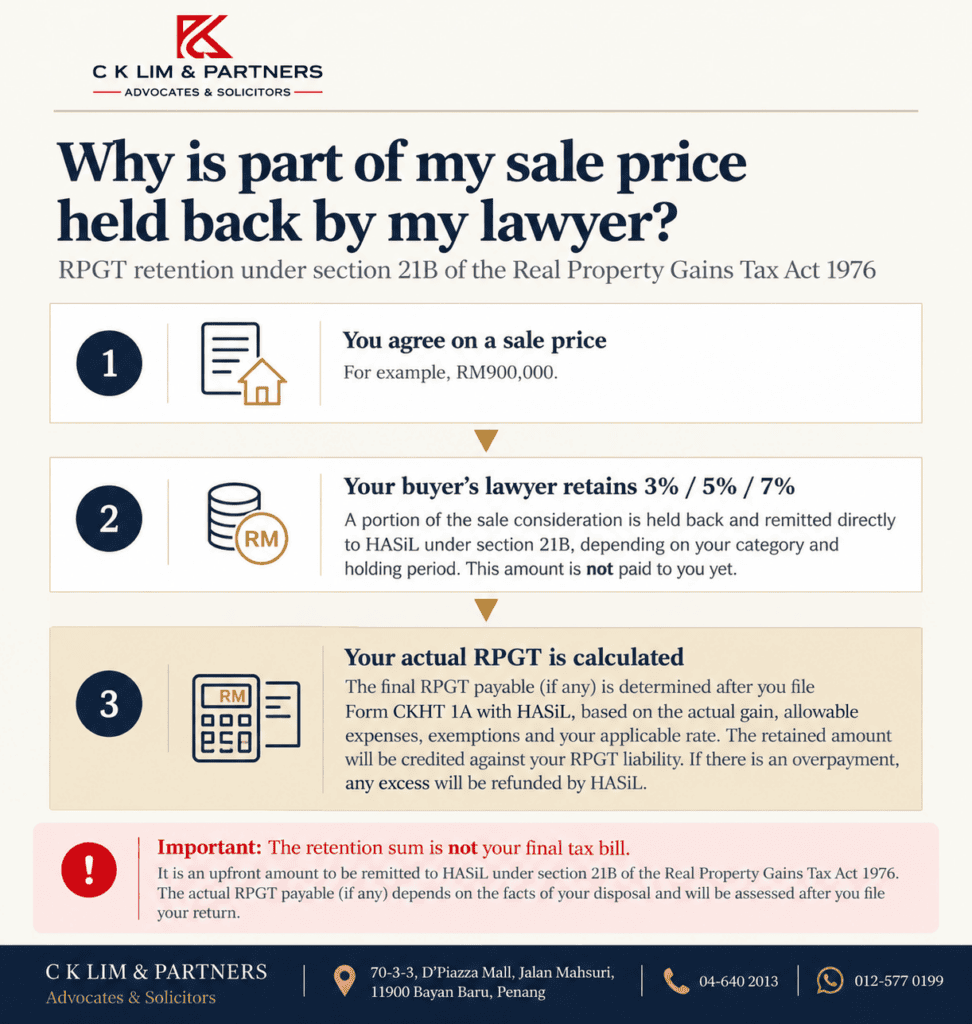
6. RPGT and the 3% / 5% / 7% retention sum: not the same thing
A seller may be told, “The buyer’s lawyer is retaining 3% for RPGT,” and assume RPGT is 3%. That is not necessarily correct.
Under section 21B of the Real Property Gains Tax Act 1976, the buyer must retain part of the purchase price and remit it to HASiL. The buyer retains and remits the lower of the total money consideration and the prescribed percentage of the total consideration. This is a collection mechanism, not the calculation of the seller’s final tax. HASiL’s current rates are:
Category of disposer | Retention / remittance |
Part I | 3% |
Part II, disposal within 3 years | 5% |
Part II, 4th year onwards | 3% |
Part III | 7% |
The buyer must remit within 60 days after the disposal date. The amount remitted counts towards the seller’s tax.
Does the buyer pay the seller’s RPGT?
No. RPGT is the seller’s liability. The buyer only retains and remits the prescribed amount as a statutory step, which is why part of the price may not be released to the seller straight away.
Why was 3% retained when my actual RPGT is nil?
Because the retention and the final computation are different things. If the amount remitted is more than the tax finally due, the seller can claim a refund. HASiL allows refunds where the SPA is cancelled, the disposal is exempt or not taxable, tax was overpaid, or an increase is remitted. The claim must be made within five years after the end of the relevant year of assessment. Refunds are paid to the seller unless the seller signs a statutory declaration authorising payment to the buyer.
7. How and when do I file and pay RPGT? (self-assessment since 2025)
For disposals from 1 January 2025, RPGT is on a self-assessment system (STS CKHT). The seller works out the gain and the tax in the return. HASiL issues no notice of assessment; the return is treated as a notice of assessment served on the date it is filed.
Electronic filing only. e-CKHT on the MyTax portal has been mandatory since 1 January 2025. A paper return is treated as not filed. The taxpayer needs a Tax Identification Number (TIN) and a digital certificate. A lawyer can file through the MyTax lawyer role and a licensed tax agent through the TaeF system.
Forms. The seller files CKHT 1A (real property) or CKHT 1B (shares), or CKHT 3 (notification that the disposal is not taxable or is exempt, including the section 8 election). The buyer files CKHT 2A. Each seller and each buyer files a separate form.
60 days after the disposal date to file (or a written extension from HASiL).
90 days from the disposal date to pay any tax not covered by the buyer’s section 21B remittance. Late payment attracts a 10% increase. From 1 January 2026, HASiL allows instalments for a deemed assessment, on terms it sets.
Amending the return. A seller who filed on time may amend once, within six months after the filing deadline, to correct under-reported gain, over-claimed costs, or a wrong acquisition or disposal date. The additional tax carries a 10% increase.
Penalties. Failing to file CKHT 1A/1B within 60 days can attract a penalty of up to three times the tax, or prosecution with a fine of up to RM5,000, or up to 12 months’ imprisonment, or both. A false statement can attract a penalty equal to the tax under-reported. A wrong CKHT 3 notification that causes the buyer not to remit can add a 10% levy. A buyer who fails to file CKHT 2A within 60 days faces the same prosecution exposure.
No return needed where the seller’s gain is taxed under the Income Tax Act (for example a developer selling a unit), and the buyer of such a unit need not file CKHT 2A.
8. RPGT when selling an inherited property in Malaysia
Inheriting a property and later selling it are two different events. Families often say, “My father bought this house 30 years ago, so if I inherit and sell it there is no RPGT.” That assumption can be wrong
Is RPGT payable when the property passes from the deceased to the estate or beneficiary?
No. For the devolution of a deceased person’s property on the executor or legatee, under a will or intestacy, the disposal price is deemed equal to the acquisition price, so no gain or loss arises on that devolution. A later sale to an outside buyer is a separate disposal.
What is the acquisition date and price of an inherited property?
Executor: the acquisition date is the date of death, and the acquisition price is the market value at the date of death, less any compensation for damage, insurance sums received, or forfeited deposit (the paragraph 4(1)(a)–(c) adjustments).
Beneficiary (legatee): where the executor transfers the property to a legatee, the acquisition date is the date of transfer, and the acquisition price is the market value at the date of transfer, less the same adjustments. The same date-of-transfer rule applies where a property is received in place of a money legacy (with the acquisition price capped at the lower of market value and the legacy).
Worked example (hypothetical figures).
A Malaysian citizen bought a Penang house years ago for RM200,000 and died. Its market value at death was RM800,000. Fourteen months later the executor sells it for RM900,000, with agent and legal fees on the sale of RM25,000.
- Acquisition price: RM800,000 (market value at date of death), not RM200,000.
- Disposal price: RM900,000 − RM25,000 = RM875,000.
- Gain: RM75,000. Because the executor acquired the property at the date of death and the disposal occurs within three years, the applicable Part I rate in this example is 30%. The amount before considering any exemption, allowable loss or other adjustment that may be available is RM22,500.
- The ordinary 3% section 21B amount would be RM27,000. From Year of Assessment 2026, however, where the disposer notifies the acquirer of the deemed assessment amount before remittance and the statutory requirements are satisfied, the acquirer may remit the applicable lower amount. If an excess has already been remitted, the disposer may instead have to seek a refund from HASiL.
If the deceased had been neither a citizen nor a permanent resident, the executor is a Part III disposer and different rates apply.
Should beneficiaries transfer the property to themselves first, or sell directly from the estate?
Ask this before completing the administration, not after. There are broadly two structures, depending on the title and the estate:
- Route A: deceased → executor/administrator → beneficiary → buyer.
- Route B: estate → buyer.
The statutory acquisition date differs between the two structures. Where the executor sells directly, the executor’s acquisition date is generally the date of death. Where the property is first transferred to a beneficiary, the beneficiary’s acquisition date is generally the date of transfer to that beneficiary. Accordingly, the applicable holding period and acquisition value should be established before deciding how the property is to be dealt with.
RPGT is not the only consideration. A conveyancing lawyer should also look at:
- whether there is a will, and whether probate or letters of administration have been obtained;
- the number of beneficiaries and whether all agree to sell;
- whether transmission has been registered;
- whether the title is leasehold, has restrictions in interest, or needs State Authority consent;
- whether any beneficiary is a foreigner or overseas;
- existing loans or charges; and
- the intended timing of the sale.
What if several siblings inherit one property and want to sell?
Before putting the property on the market, and before accepting an earnest deposit, establish:
1. Who is legally entitled to the property?
2. Has probate or letters of administration been obtained, and does the executor or administrator have authority?
3. Has the property already been transmitted or transferred?
4. Do all relevant parties agree to the sale, and who will sign the SPA and transfer documents?
5. What acquisition date and value apply for RPGT, and is valuation evidence available?
6. Is State consent required, and are any beneficiaries overseas?
9. Can I transfer property to my family instead of selling it?
A transfer by way of love and affection is legally different from a sale. For RPGT, a gift is ordinarily deemed a disposal at market value. However, where the gift is between husband and wife, parent and child, or grandparent and grandchild, the donor is treated as making no gain and no loss. Since 1 January 2017 the donor must be a Malaysian citizen to qualify.
Other no-gain/no-loss transfers. Transfers between spouses (restricted, since 1 January 2018, to Malaysian citizens) and transfers between former spouses under a court order on divorce or annulment (transferor must be a Malaysian citizen) are also treated as no gain/no loss.
Brothers and sisters. A gift between siblings is not one of the listed relationships, so it falls back to the general rule that a gift is a disposal at market value. Stamp duty, State consent, title restrictions and financing must be considered separately.
Even where RPGT is neutral, a family transfer is not automatically tax-free in every respect.
10. What documents should I give my conveyancing lawyer?
If you plan to sell, provide these early: your previous SPA; the title or strata title; the previous legal fee invoice; stamp duty evidence; the estate agent’s invoice; invoices for qualifying renovations; valuation reports; loan redemption information; your identity documents; and documents about any earlier transfer, inheritance or gift.
For inherited property, also provide the death certificate, will, Grant of Probate or Letters of Administration, any distribution order, documents showing how the property passed through the estate, and valuation evidence at the relevant date.
11. Planning to sell? Check these 8 things before accepting an offer
- Who is the registered owner?
- When was the property acquired for RPGT purposes?
- What RPGT category does the seller fall under?
- What was the acquisition price?
- What deductible costs and supporting documents are available?
- Is an exemption potentially available?
- What section 21B amount may be retained from the price?
- How much will remain after RPGT, loan redemption, agent’s commission and other costs?
The figure that matters is not the selling price. It is your estimated net proceeds.
12. Frequently asked questions about RPGT in Malaysia
1. Is RPGT charged on the selling price?
No. RPGT is charged on the chargeable gain, worked out from the disposal price, acquisition price, allowable expenses, exemptions and losses.
2. Is there RPGT after 5 years?
For Part I disposers, including Malaysian citizen and permanent resident individuals, the rate from the 6th year is nil. Part II and Part III disposers pay 10%.
3. Is RPGT the same as the 3% retained by the buyer?
No. The section 21B retention is a collection mechanism. Your final tax may be higher, lower or nil, and any excess can be refunded.
4. Can renovation costs reduce RPGT?
Yes, where the expenditure enhances or preserves the property’s value, is reflected in the property when sold, and is properly documented. Spending before 1 January 2013 on property acquired before that date is not allowed for Part I disposers.
5. Can I deduct legal fees and housing loan interest?
Professional fees on acquiring and selling the property can be included. Loan interest and fees for preparing the RPGT return cannot.
6. Is inherited property exempt from RPGT?
No. The devolution from the deceased’s estate has no gain or loss, but a later sale to a buyer is a separate disposal.
7. Do I use my late parent’s original purchase price?
No. The executor’s acquisition price is the market value at the date of death, and a beneficiary’s is the market value at the date of transfer.
8. Can I transfer property to my child without RPGT?
A gift from a Malaysian citizen to a child can be treated as no gain and no loss. Stamp duty and other matters are separate.
9. Who files the RPGT forms, and when?
The seller (through a lawyer or licensed tax agent if appointed) files CKHT 1A on e-CKHT within 60 days of the disposal date. Any tax balance is due within 90 days.
10. Can a seller correct the return after filing?
Yes, once, within six months after the filing deadline, with a 10% increase on any additional tax.
11. Is the RPGT refundable if the sale is cancelled?
Yes. Amounts paid can be refunded on cancellation of the SPA, on proof such as a deed of revocation, within five years after the end of the relevant year of assessment.
Final Thoughts
RPGT should be considered before a seller commits to a property transaction, particularly where the property was acquired recently, inherited from a deceased owner, transferred between family members or is owned by a foreign individual.
The selling price alone does not determine the RPGT payable. The correct treatment depends on the disposer’s category, the statutory acquisition and disposal dates, the acquisition and disposal prices determined under the RPGT rules, allowable expenditure, available exemptions and any section 21B amount remitted by the purchaser.
For inherited property, the position requires particular care because the acquisition date and acquisition value may differ depending on whether the property is being sold by the executor or administrator, or has first been transferred to a beneficiary.
Before accepting an offer, sellers should therefore establish the likely RPGT position together with the loan redemption amount, estate agency fees, legal costs and other deductions so that the expected net sale proceeds are properly understood.
OTHER RELATED
- Buying Property in Malaysia (2026): Complete Subsale and Conveyancing Legal Guide
- Perfection of Transfer (POT) & Perfection of Charge (POC) in Malaysia: A Complete Guide for Property Owners
- Foreigner Stamp Duty in Malaysia (2026): Everything Foreign Buyers Need to Know Before Buying Property
- Can Foreigners, MM2H Holders and Permanent Residents Buy Property in Penang? Penang Controlled Pricing Explained
- Vacant Possession in Malaysia: What Property Purchasers Must Check Before and After Completion (Including “As Is Where Is” Explained)
- Subsale Conveyancing FAQ in Penang
- Foreign Buyer Stamp Duty Doubled to 8% in 2026 — What Changed
- Conveyancing Tip: Why Perfection of Transfer (POT) Is Crucial in Malaysia
- Understanding Stamp Duty for Property Purchases and Transfers in Malaysia
- A Guide to Conveyancing in Malaysia
- First time homebuyers things you need to know
DISCLAIMER
The information contained in this article is provided for general informational and educational purposes only and does not constitute legal, tax, financial or professional advice. Whilst every effort has been made to ensure that the information is accurate and up to date as at the date of publication, the law, governmental policies and administrative practices may change from time to time.
The application of the law depends on the specific facts and circumstances of each transaction. Accordingly, readers should not rely on this article as a substitute for obtaining independent legal advice. Before making any decision relating to the purchase, sale or transfer of property in Malaysia, you should consult a qualified legal practitioner to obtain advice tailored to your particular circumstances.
C K LIM & PARTNERS accepts no responsibility or liability for any loss or damage arising from any reliance placed on the information contained in this article without first obtaining appropriate legal advice.
Selling a property in Penang?
If you plan to sell a residential, commercial or inherited property in Penang, have the legal and RPGT position reviewed before you commit. At C K Lim & Partners we act in subsale conveyancing, sale and purchase agreements, sale of inherited property, family property transfers, perfection of transfer and charge, loan redemption and discharge, probate and letters of administration connected with property, and RPGT/CKHT matters arising from conveyancing.