
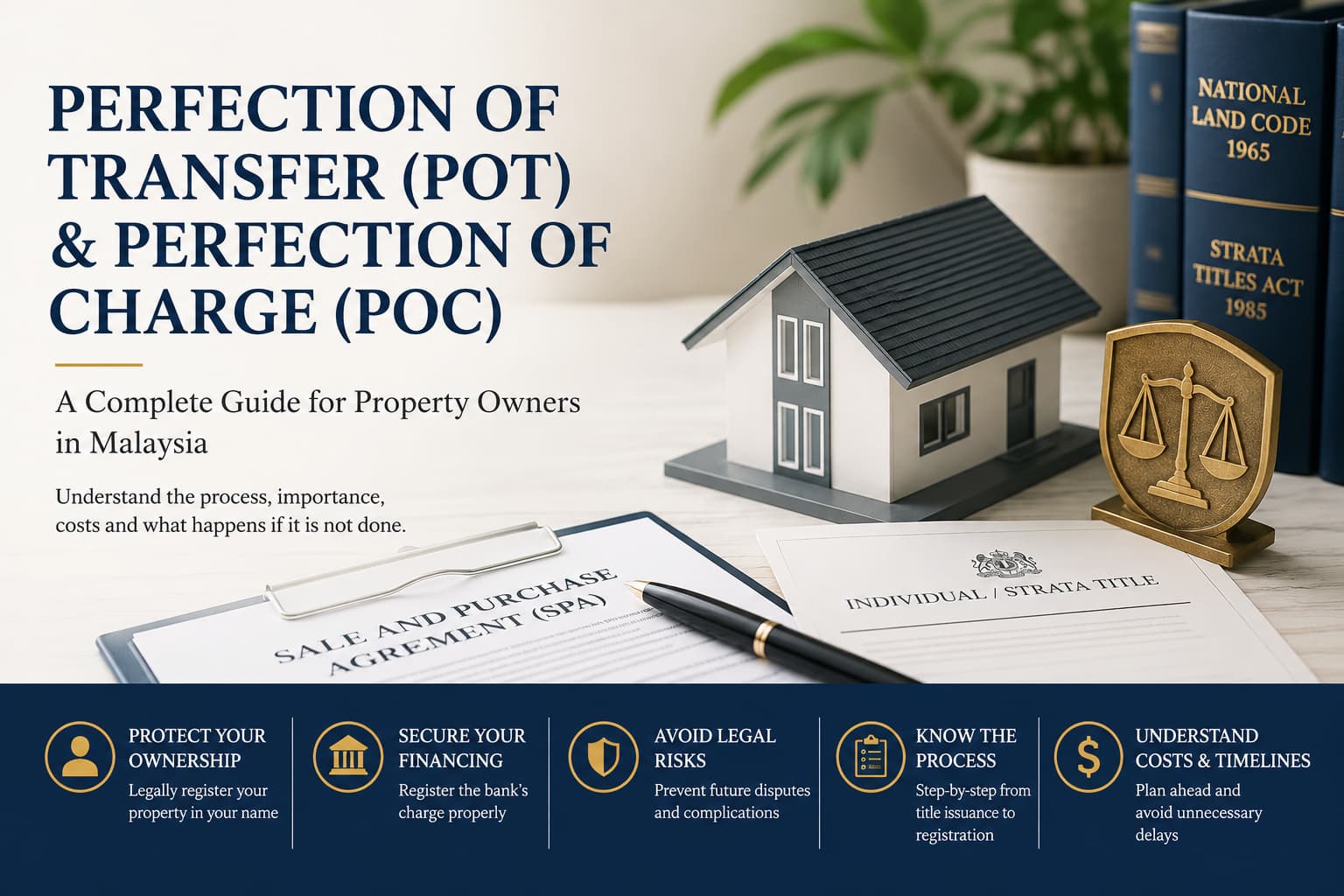
Perfection of Transfer (POT) & Perfection of Charge (POC) in Malaysia: A Complete Guide for Property Owners
Perfection of Transfer (POT) & Perfection of Charge (POC) in Malaysia: A Complete Guide for Property Owners
Purchasing a property is one of the most significant financial commitments that many Malaysians will make during their lifetime. After signing the Sale and Purchase Agreement (SPA), obtaining a housing loan, paying the purchase price and collecting the keys, many purchasers understandably assume that the legal process has been completed.
However, for many properties purchased directly from developers, and certain subsale transactions where the individual title or strata title had not yet been issued, there is a further legal process that commonly takes place after the individual title or strata title has been issued. This process is widely known within the Malaysian conveyancing industry as Perfection of Transfer (POT) and Perfection of Charge (POC).
Many property owners only encounter these terms years after purchasing their property, usually when they receive a notice from the developer requesting them to complete the necessary registration process. This often raises questions such as:
- What are Perfection of Transfer (POT) and Perfection of Charge (POC)?
- Why am I only receiving this notice years after purchasing my property?
- Do I need to complete the process?
- What happens if I decide to delay it?
- Can I still sell or refinance my property?
- What documents are required?
- How long does the process take?
- Can I appoint my own solicitor?
This guide has been prepared to answer these and other commonly asked questions in a clear and practical manner. It is intended for purchasers, property owners, executors, administrators and anyone involved in dealing with a property where the individual title or strata title has been issued after the original purchase from a developer.
Whether you are responding to a recent notice from your developer or planning a future property transaction, understanding how the perfection process works will help you make informed decisions and avoid unnecessary complications.
About the Author
This guide is written by Doreen Lim, Advocate & Solicitor of the High Court of Malaya and Partner of C K Lim & Partners, with more than 15 years of experience in Malaysian conveyancing, property transfers, refinancing, estate administration and probate matters. The firm has acted for thousands of Malaysian property transactions and regularly advises purchasers on Perfection of Transfer (POT) and Perfection of Charge (POC).
Key Facts About POT & POC
Question | Short Answer |
What is Perfection of Transfer (POT)? | The legal process of registering the purchaser as the registered proprietor after the individual or strata title has been issued. |
What is Perfection of Charge (POC)? | The legal process of registering the financier’s charge over the property after the title has been issued where the property is financed. |
Who usually needs this process? | Purchasers who bought a property directly from a developer before the individual or strata title was issued, and purchasers involved in certain subsale transactions involving a property without a separate title. |
Why am I receiving a notice now? | Because the individual or strata title has been issued and the registration process can now proceed. |
Can I delay the process? | Delaying the process may lead to practical complications in future property transactions. |
Can I appoint my own solicitor? | Yes. A purchaser is generally entitled to appoint a solicitor of his or her own choice for the Perfection of Transfer. Where Perfection of Charge is required, the financier’s panel requirements may apply. |
Glossary
Term | Meaning |
POT | Perfection of Transfer |
POC | Perfection of Charge |
DOA | Deed of Assignment |
MOT | Memorandum of Transfer (Form 14A) |
Charge | A registered security interest in favour of a financier over the property. |
Registered Proprietor | Person whose name appears on the title |
What You Will Learn in This Guide
For ease of reference, this guide is organised into the following sections:
1. Understanding POT & POC
Learn what the perfection process is, who usually needs it, why developers issue notices years after a property purchase, and where the process fits within the overall property ownership journey.
2. Understanding the Legal Concepts
Understand the legal concepts behind the perfection process, including beneficial ownership, registered proprietorship, the Deed of Assignment, the Memorandum of Transfer (Form 14A), and the distinction between Perfection of Transfer and Perfection of Charge.
3. Why the Perfection Process Matters
Learn the practical implications of delaying the registration process, whether it is compulsory, whether you can sell or refinance your property before completion, what happens if an owner passes away, and common misconceptions about the process.
4. The Registration Process Step by Step
Follow the registration process from the issuance of the title through to registration, including the roles of the developer, purchaser, financier and solicitor.
5. Costs, Documents and Practical Matters
Understand the documents commonly required, the factors affecting legal costs, the expected timeline and other practical issues frequently encountered during the registration process.
6. Frequently Asked Questions and Real-Life Scenarios
Explore answers to frequently asked questions together with practical examples illustrating how the process applies in different situations.
Received a Perfection of Transfer Notice?
1. Understanding Perfection of Transfer & Perfection of Charge
Before examining the legal concepts and registration procedures, it is helpful to understand what is commonly referred to as Perfection of Transfer (POT) and Perfection of Charge (POC), who is usually affected, and why these processes arise years after a property has been purchased.
What Is Commonly Known as Perfection of Transfer & Perfection of Charge?
The expression “Perfection of Transfer and Perfection of Charge” is a commonly used conveyancing term describing two separate registration processes that usually take place after the individual title or strata title has been issued for a property purchased directly from a developer.
These two processes are:
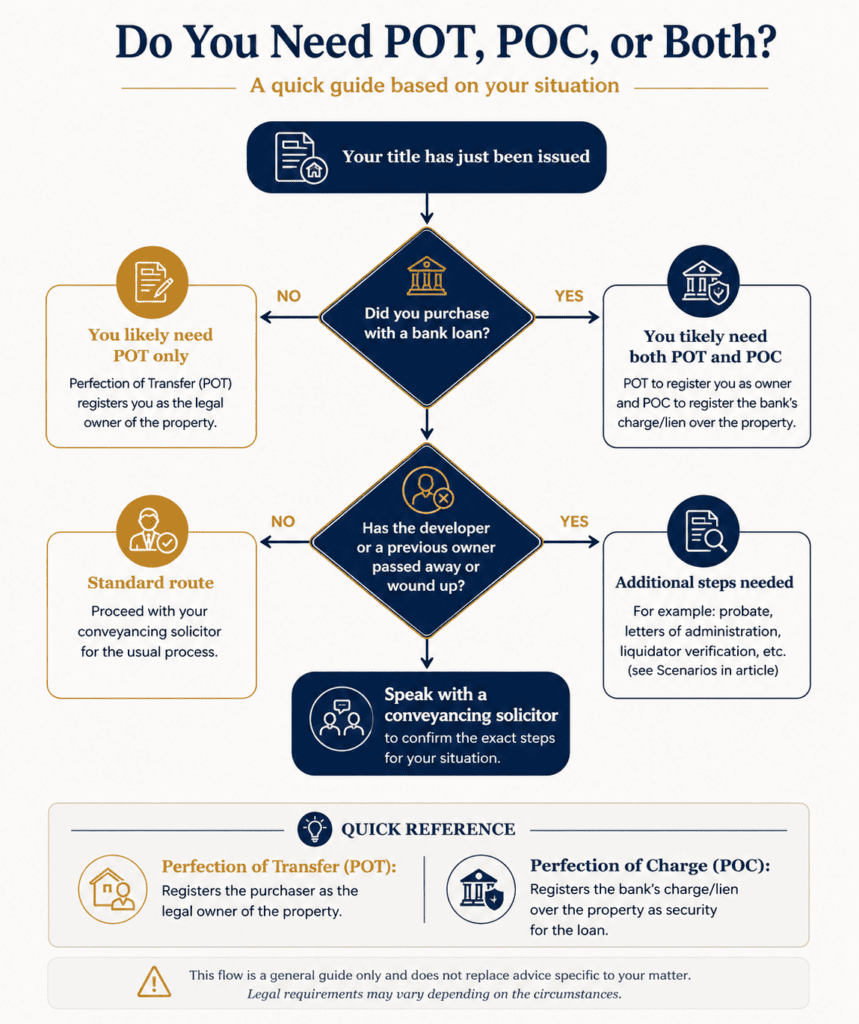
- Perfection of Transfer (POT), which registers the purchaser as the registered proprietor of the property; and
- Perfection of Charge (POC), which registers the financier’s charge over the property where the purchase was financed by a housing loan.
Although the two processes are often carried out as part of the same conveyancing exercise, they serve different legal purposes and involve different legal documents and registration requirements.
The legal concepts underlying these two processes are explained in the next section of this guide.
Who Usually Needs to Complete the Perfection Process?
The perfection process commonly applies to purchasers who purchased a property directly from a developer before the individual title or strata title was issued. It may also arise in certain subsale transactions where the property was sold before the separate title was issued and the subsequent purchaser acquired the contractual and beneficial interest by way of assignment.
This commonly includes properties such as:
- landed residential houses;
- apartments;
- condominiums;
- serviced apartments;
- commercial suites;
- offices; and
- other stratified developments.
When these properties are first sold, or in some situations of subsale cases, the development is often still held under a master title. As a result, ownership cannot immediately be registered in the purchaser’s name.
Only after the individual title or strata title has been issued can the necessary registration process be completed.
By contrast, purchasers of subsale properties where the individual or strata title had already been issued and ownership was transferred through a registered Memorandum of Transfer as part of the purchase transaction will generally not undergo a separate perfection process arising from that transaction.
As every transaction is different, purchasers who are unsure whether the perfection process applies to their property should obtain legal advice.
Why Did I Receive a Notice Years After Buying My Property?
Many purchasers receive a notice from the developer several years after collecting vacant possession and moving into their property.
This is entirely normal.
When the property was originally purchased, the individual title or strata title may not yet have been available. Consequently, ownership could not be registered in the purchaser’s name at that time.
Once the relevant title has been issued, the developer will usually notify purchasers so that the necessary registration process can be carried out. Where the property is financed by a housing loan, the financier’s security may also need to be registered against the title.
Accordingly, receiving such a notice does not generally indicate that there is a problem with the property. Rather, it signifies that the next stage of the conveyancing process can now proceed.
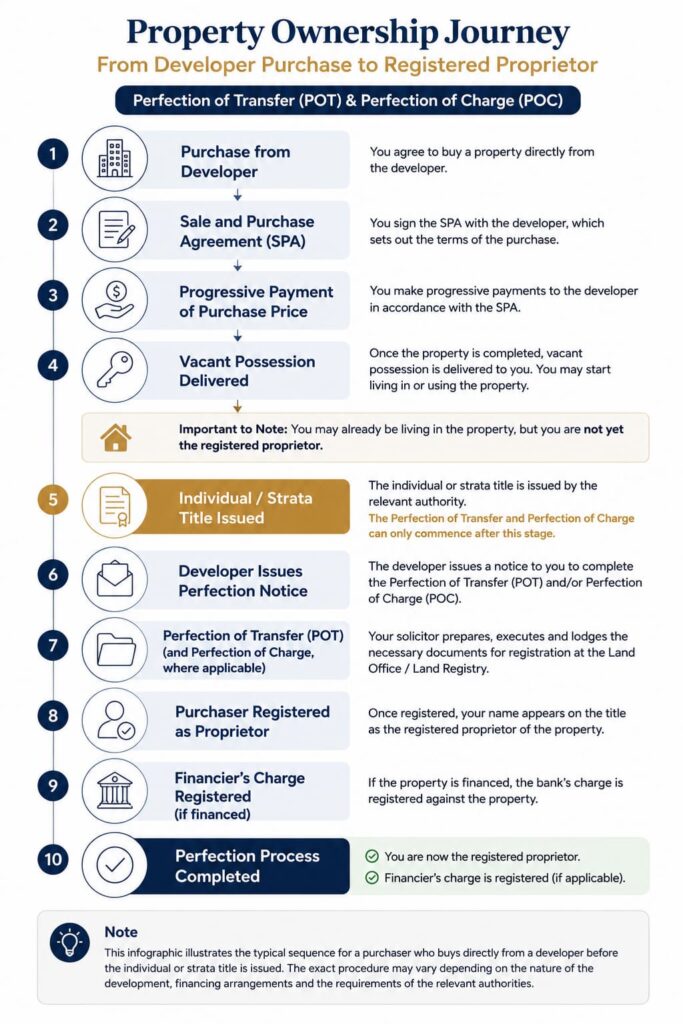
The Typical Property Ownership Journey
The following illustration shows where the perfection process generally fits within the lifecycle of a developer property.
Purchase Property from Developer
│
Sale and Purchase Agreement
│
Completion of Purchase
│
Vacant Possession
│
Individual / Strata Title Issued
│
Developer Issues Notice
│
Registration Process
│
Registration of Ownership
│
Registration of Financier’s Charge (if applicable)
The above illustration is a simplified overview. The exact process may vary depending on the nature of the development, the financing arrangements and the requirements of the relevant authorities.
2. Understanding the Legal Concepts
Many property owners receive a Perfection of Transfer (“POT”) or Perfection of Charge (“POC”) notice without fully understanding the legal concepts behind the process. Terms such as beneficial owner, registered proprietor, Deed of Assignment, Memorandum of Transfer (Form 14A) and Charge are frequently used in conveyancing, but are often misunderstood.
Understanding these concepts is essential because they determine who legally owns the property, how ownership is transferred, and why the perfection process becomes necessary once the individual or strata title has been issued.
Beneficial Ownership vs Registered Ownership
One of the most common misconceptions is that a purchaser automatically becomes the registered owner immediately after purchasing a property from a developer.
From a practical perspective, the purchaser may have:
- paid the purchase price;
- taken vacant possession;
- moved into the property;
- paid quit rent, assessment rates and maintenance charges; and
- exercised the rights of ownership over the property.
However, where the individual title or strata title has not yet been issued, the purchaser cannot yet be registered as the proprietor of the particular property or parcel. The purchaser’s interest is instead evidenced by the Sale and Purchase Agreement and, where applicable, the relevant assignment and transaction documents.
Once the Perfection of Transfer has been registered, the purchaser becomes the registered proprietor of the property.
This distinction is particularly important when dealing with future transactions involving the property, such as a sale, refinancing or estate administration.
Beneficial Ownership and Registered Ownership at a Glance
Beneficial Ownership | Registered Ownership |
Arises through the contractual transaction documents. | Arises upon registration under the relevant land registration system. |
Evidenced by the Sale and Purchase Agreement and other relevant transaction documents and, where applicable, the developer’s records or confirmation. | Verified through the land register, commonly by conducting an official land search. |
Commonly exists before the individual or strata title is issued. | Occurs after the title has been issued and the transfer has been registered. |
What Is a Deed of Assignment?
Where the individual title or strata title has not yet been issued, ownership cannot be transferred through the registration of a Memorandum of Transfer.
In an original purchase directly from a developer, the purchaser’s contractual and beneficial interest generally arises under the Sale and Purchase Agreement and the related transaction documents.
If that purchaser subsequently sells the property before the separate title is issued, the purchaser’s contractual rights and beneficial interest are commonly assigned to the subsequent purchaser through a Deed of Assignment.
The Deed of Assignment therefore plays a particularly important role in subsale transactions involving properties without an issued individual or strata title. Once the separate title is issued, registered ownership may be transferred through the applicable registration process.
What Is Form 14A (Memorandum of Transfer)?
A Memorandum of Transfer (Form 14A) is the prescribed instrument used to transfer registered ownership of land or a parcel where the relevant title is available.
Upon registration at the Land Office or Land Registry, the transferee becomes the registered proprietor of the property.
In the context of developer projects, Form 14A is commonly executed after the individual or strata title has been issued as part of the Perfection of Transfer process.
Deed of Assignment vs Memorandum of Transfer (Form 14A)
Although both documents relate to the transfer of property rights, they are used at different stages of the conveyancing process.
| Deed of Assignment | Memorandum of Transfer (Form 14A) |
|---|---|
| Commonly used in a subsale where the individual or strata title has not yet been issued. | Used where the individual or strata title has been issued. |
| Assigns the assignor’s contractual rights and beneficial interest to the assignee. | Transfers registered ownership to the transferee upon registration. |
| Notice of the assignment is ordinarily given to the developer or relevant stakeholder. | The transfer is presented for registration at the Land Office or Land Registry. |
| Does not by itself change the registered proprietor appearing on the title. | Changes the registered proprietor upon successful registration. |
Perfection of Transfer vs Perfection of Charge
Although Perfection of Transfer and Perfection of Charge are commonly completed during the same conveyancing exercise, they serve different legal purposes.
Perfection of Transfer | Perfection of Charge |
Registers the purchaser as the registered proprietor. | Registers the financier’s charge over the property. |
Relates to ownership of the property. | Relates to the financier’s security for the housing loan. |
Primarily involves the developer and purchaser. | Primarily involves the purchaser and the financier. |
Results in the purchaser being recorded as the registered proprietor. | Results in the financier becoming the registered chargee. |
Understanding the distinction between these two processes helps explain why different legal documents are prepared and why both registrations are commonly completed together after the individual or strata title has been issued.
3. Why the Perfection Process Matters
After understanding the legal concepts behind Perfection of Transfer and Perfection of Charge, many property owners ask a practical question:
“I moved into my property years ago. Do I still need to complete the perfection process?”
The short answer is yes, in most cases you should.
Delaying the perfection process may not immediately affect your day-to-day occupation of the property. However, it can give rise to unnecessary legal, administrative and practical difficulties when you later wish to sell, refinance or otherwise deal with the property.
The following are some of the principal reasons why purchasers should generally complete the perfection process once requested by the developer.
1. Register Your Ownership as the Registered Proprietor
One of the primary purposes of the Perfection of Transfer is to register the purchaser as the registered proprietor of the property after the individual title or strata title has been issued.
Until the transfer has been registered, the land register may continue to show the developer as the registered proprietor, notwithstanding that the purchaser has already completed the purchase and taken possession of the property.
Completing the Perfection of Transfer ensures that the land register accurately reflects the purchaser’s registered ownership.
2. Avoid Complications if the Developer Is Wound Up
This is one of the most overlooked risks of delaying the perfection process.
If the developer is wound up before the transfer has been completed, the transfer cannot simply proceed as though nothing has happened.
Instead, the liquidator assumes control of the developer’s affairs and must satisfy himself or herself that the purchaser is legally entitled to the property before completing the transfer.
Depending on the circumstances, the liquidator may need to review documents such as:
- the Sale and Purchase Agreement;
- proof of payment of the purchase price;
- financing and redemption documents;
- correspondence with the developer;
- assignment documents; and
- other historical records relating to the transaction.
Where records are incomplete or clarification is required, the verification process can take a considerable period of time.
In practice, transactions involving developers in liquidation are often significantly more complex than ordinary perfection matters and may take many months or, in some cases, even years before the transfer can be completed.
Completing the perfection process while the developer remains operational can therefore help avoid substantial delays and additional legal work in the future.
3. Avoid Additional Developer Administrative or Storage Charges
Some developers reserve the right under their transaction documents or administrative policies to impose storage, custody or administrative charges where purchasers fail to complete the perfection process within the stipulated period. The applicable charges vary from developer to developer and should be verified from the relevant Sale and Purchase Agreement or the developer’s prevailing administrative requirements.
Whether such charges are payable depends on the terms of the Sale and Purchase Agreement, the relevant documentation and the developer’s requirements.
Although not every developer imposes such charges, unnecessary delay may result in avoidable additional costs.
Purchasers should therefore review the developer’s notice carefully and clarify whether any administrative charges may arise if the matter remains outstanding.
4. Facilitate Future Sale Transactions
Many property owners only discover that their perfection process remains outstanding when they decide to sell their property.
Although an outstanding Perfection of Transfer does not necessarily prevent a sale from proceeding, it may affect the structure, documentation and timing of the transaction.
Depending on the circumstances, additional legal steps may be required before or as part of the sale.
For example, the transaction may involve:
- completing the outstanding Perfection of Transfer before the onward transfer;
- coordinating the perfection process with the sale transaction; or
- where legally and administratively permissible, arranging a direct transfer from the developer to the purchaser.
The appropriate structure depends on the title status, the financing arrangements, the developer’s requirements and the circumstances of the transaction.
Completing the perfection process earlier often allows a future sale to proceed more efficiently.
5. Facilitate Future Refinancing
Similar issues may arise when refinancing a property.
Where the title has already been issued but the transfer and charge have not been perfected, the incoming financier may require the title position and security structure to be regularised before completing the refinancing.
Depending on the transaction, this may involve:
- completing the Perfection of Transfer;
- dealing with the existing financier’s security;
- registering the new financier’s charge; and
- satisfying the incoming financier’s documentation requirements.
Addressing these matters in advance can help avoid unnecessary delays when refinancing becomes time-sensitive.
6. Simplify Future Estate Administration
Property owners often do not consider what may happen if they pass away before the perfection process has been completed.
Where this occurs, the deceased purchaser’s interest forms part of the estate and must be dealt with by the executor or administrator together with the outstanding title position.
Depending on the circumstances, the estate may need to coordinate:
- the Grant of Probate or Letters of Administration;
- the outstanding perfection process;
- transmission of ownership;
- distribution of the estate; or
- a subsequent sale of the property.
This frequently involves more documentation and procedural steps than would have been required had the perfection process been completed during the purchaser’s lifetime.
Completing the registration while the owner is alive may therefore simplify future estate administration for family members.
7. Avoid Additional Complications as Circumstances Change
The longer the perfection process remains outstanding, the greater the likelihood that circumstances will change.
Examples include:
- a purchaser passes away;
- a joint owner loses mental capacity;
- a purchaser relocates overseas;
- names or identification details change;
- original transaction documents are misplaced;
- the original financier merges with another financial institution; or
- the developer undergoes restructuring.
Each of these events may result in additional documentation, verification or procedural requirements.
Completing the perfection process promptly often avoids these unnecessary complications.
Can I Simply Ignore the Developer's Notice?
Ignoring the developer’s notice does not ordinarily make the need for the perfection process disappear.
Instead, the outstanding registration will usually have to be addressed when the property is eventually sold, refinanced, transmitted to beneficiaries or otherwise dealt with.
In many cases, postponing the process merely means that it will need to be completed later, often when the transaction has become more urgent or the circumstances have become more complicated.
For this reason, purchasers who receive a notice from the developer should generally review it promptly and obtain legal advice if they are uncertain about the appropriate course of action.
Common Misconceptions About the Perfection Process
Myth | Position |
“I’ve collected the keys, so everything has been completed.” | Vacant possession and registration of ownership are separate stages of the conveyancing process. |
“I’ve fully paid for the property, so I’m already registered as the owner.” | Payment alone does not register ownership on the title. |
“I can deal with the perfection process whenever I decide to sell.” | Delaying the process may result in additional legal steps, documentation and delays when the property is eventually sold. |
“If the developer is wound up, the transfer can still be completed as usual.” | A developer’s liquidation may substantially complicate and delay the transfer process because the liquidator must first verify the purchaser’s entitlement before completing the transfer. |
“Since my housing loan has been fully settled, I don’t need to complete anything further.” | Loan settlement does not automatically register the purchaser as the registered proprietor. The title position should still be reviewed. |
4. The Perfection Process Step by Step
Having understood the legal concepts and the importance of completing the perfection process, the next question is how the process is actually carried out.
Although every transaction is different, the perfection process generally follows a similar sequence once the individual title or strata title has been issued.
The precise procedure may vary depending on factors such as the type of property, whether the property is financed, the developer’s requirements, and the requirements of the relevant Land Office or Land Registry.
The Legal Framework
The perfection process is governed by the applicable contractual documents executed during the original purchase together with the relevant legislation governing land registration.
Depending on the circumstances of the transaction, these may include:
- the National Land Code 1965 [Act 828];
- the Strata Titles Act 1985 (where applicable);
- the Housing Development (Control and Licensing) Act 1966 and the prescribed Sale and Purchase Agreement (where applicable);
- the Sale and Purchase Agreement;
- the Deed of Assignment;
- the Loan Agreement and security documents; and
- the developer’s requirements relating to the transfer process.
The exact documents applicable will depend on the nature of the development and the particular transaction.
Step 1 – The Individual or Strata Title Is Issued
The perfection process normally begins only after the individual title or strata title has been issued for the property.
Before this stage, there is generally no separate title capable of being transferred into the purchaser’s name.
Once the title has been issued, the developer is able to commence the transfer process.
Step 2 – The Developer Issues a Notice to the Purchaser
The developer will usually notify the purchaser that the title has been issued and request the purchaser to complete the necessary legal documentation.
The notice commonly includes:
- instructions on appointing a solicitor;
- the documents required from the purchaser;
- estimated legal fees and disbursements (where applicable);
- deadlines stipulated by the developer; and
- other administrative requirements.
Purchasers should review the notice carefully and respond within the time requested where possible.
Step 3 – Appointment of a Solicitor
The purchaser will then appoint a solicitor to act in the perfection process. The purchaser is generally entitled to appoint a solicitor of his or her own choice for the Perfection of Transfer. Where the Perfection of Charge is also required, the solicitor acting in relation to the charge may need to satisfy the financier’s panel requirements.
The solicitor’s role is to advise the purchaser, prepare and review the relevant documentation, coordinate with the developer and financier where necessary, attend to stamping (where applicable) and complete the registration process.
Step 4 – Preparation of Legal Documents
Once instructed, the solicitor will prepare or obtain the documents required for execution.
Depending on the transaction, these may include:
- the Memorandum of Transfer (Form 14A);
- the Charge instrument (where applicable);
- declarations or statutory forms;
- identity verification documents;
- financing documents;
- developer documentation; and
- other documents required by the relevant authorities.
The exact documents will vary according to the transaction.
Step 5 – Execution of Documents
The purchaser will execute the relevant documents.
If there is more than one purchaser, all parties who are required to execute the documents should do so in accordance with the applicable legal requirements.
Purchasers residing overseas may generally execute documents outside Malaysia, subject to the applicable witnessing, authentication or notarisation requirements.
After the purchaser has executed the relevant documents, the Memorandum of Transfer (Form 14A) will generally be forwarded to the developer for execution. Where the property is financed, the relevant security documents will also be forwarded to the financier for execution, where required. The exact sequence may vary depending on the developer’s procedures and the financier’s requirements.
Step 6 – Stamping and Adjudication
https://www.cklimpartners.com/understanding-stamp-duty-for-property-purchases-and-transfers-in-malaysia/Certain instruments may require adjudication and stamping before registration.
The applicable stamp duty depends on the nature of the instrument and the relevant stamp duty legislation.
The solicitor will advise:
- whether stamping is required;
- the amount payable (if any); and
the sequence in which the documents should be stamped and registered.
Step 7 – Registration at the Land Office or Land Registry
After the relevant documents have been duly executed and, where required, stamped, they are presented for registration at the relevant Land Office or Land Registry.
Upon successful registration:
- the purchaser becomes the registered proprietor; and
- where applicable, the financier’s charge is registered against the title.
The registration process is completed only when the relevant entries have been recorded in the land register.
The Roles of the Parties
Understanding the responsibilities of each party helps purchasers appreciate how the process is coordinated.
The Developer
The developer generally:
- notifies purchasers when the title has been issued;
- prepares or provides the necessary title-related documentation;
- executes documents required on its part;
coordinates the transfer process from the developer to the purchaser
The Purchaser
The purchaser generally:
- appoints a solicitor;
- provides the required documents;
- signs the legal documentation;
- pays the applicable legal costs, disbursements and registration fees; and
- cooperates in completing the registration process.
The Financier
Where the property is financed, the financier generally:
- provides instructions relating to the registration of its security;
- executes the relevant documentation where necessary; and
- coordinates with the solicitor to complete the registration of the charge.
The Solicitor
The solicitor coordinates the entire perfection process.
This commonly includes:
- advising the purchaser;
- preparing and reviewing legal documents;
- liaising with the developer;
- liaising with the financier;
- attending to adjudication and stamping where required;
- presenting documents for registration; and
- keeping the purchaser informed of the progress of the matter.
Typical Timeline
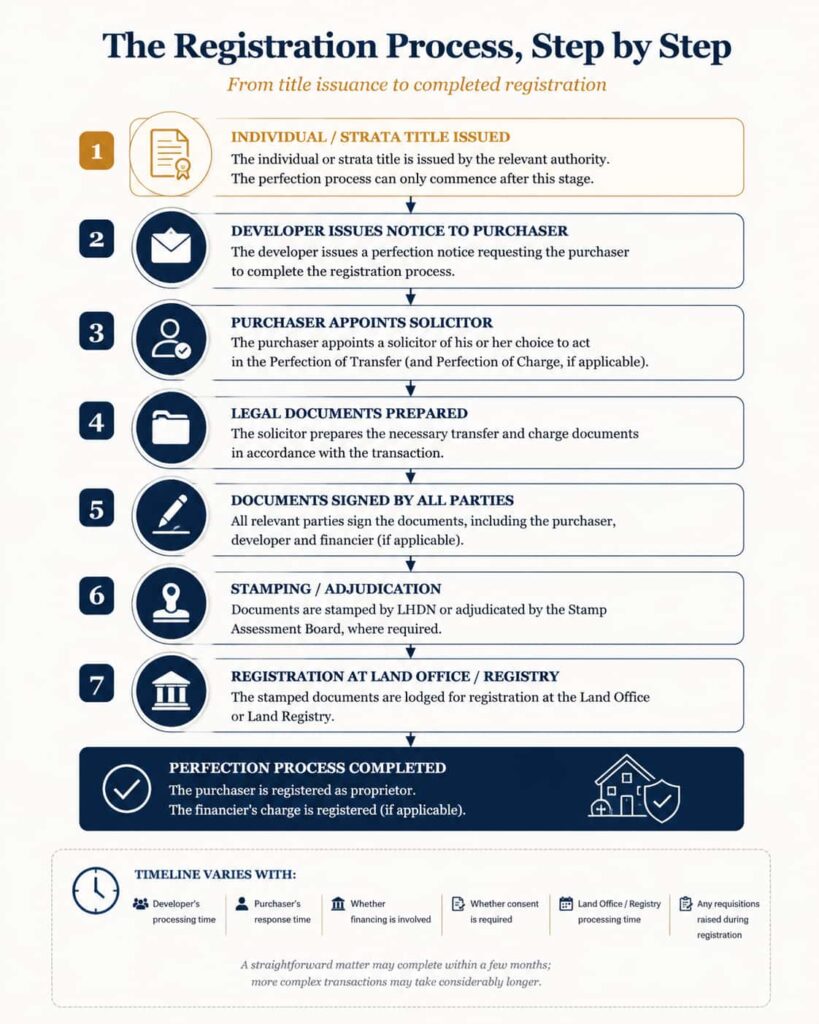
Although every transaction differs, the perfection process generally follows this sequence:
Individual / Strata Title Issued
│
▼
Developer Issues Notice
│
▼
Purchaser Appoints Solicitor
│
▼
Documents Prepared
│
▼
Documents Signed
│
▼
Stamping / Adjudication (where applicable)
│
▼
Registration at Land Office / Land Registry
│
▼
Perfection Process Completed
The time required for completion varies depending on factors such as:
- the developer’s processing time;
- the purchaser’s response time;
- whether financing is involved;
- whether consent is required;
- the Land Office or Land Registry’s processing time; and
- whether any requisitions are raised during registration.
Accordingly, there is no fixed timeframe applicable to every transaction.
5. Costs, Documents and Practical Matters
Once a purchaser decides to proceed with the perfection process, the next questions are usually practical rather than legal.
For example:
- What documents do I need to provide?
- How much will the process cost?
- How long will it take?
- Can I appoint my own solicitor?
- What if I am overseas?
- What if I have lost my original documents?
This section answers those practical questions to help purchasers prepare for the registration process.
What Documents Are Commonly Required?
The documents required will vary depending on the property, the developer’s requirements, the financing arrangements and the circumstances of the purchaser.
However, purchasers are commonly requested to provide the following documents.
Personal Documents
- Identity Card (MyKad) or passport.
- Marriage Certificate, Divorce Order or Death Certificate (where applicable).
- Updated correspondence address.
- Contact number and email address.
Property Documents
Depending on the transaction, these may include:
- Sale and Purchase Agreement.
- Deed of Assignment relating to the transfer, where applicable;
- Latest maintenance receipt and fire insurance policy (if applicable);
- Latest assessment receipt (if applicable);
- Latest quit rent receipt;
- Copy of the issued individual title or strata title (if available).
- Developer’s notice requesting completion of the perfection process.
- any document relating to a stamp duty exemption or remission, where applicable;
- a copy of any blanket consent or relevant State Authority consent, where applicable.
Financing Documents
Where the property is financed, additional documents may be required by the financier. For instance:
- Facility agreement;
- Deed of Assignment relating to the financing or security, where applicable.
These requirements differ between financial institutions and depend on the financing arrangement.
Your solicitor will advise which documents are required after reviewing your transaction.
How Much Does the Perfection Process Cost?
There is no fixed fee applicable to every perfection matter.
The total cost depends on several factors, including:
- whether the matter involves only the Perfection of Transfer or both the Perfection of Transfer and Perfection of Charge;
- the property’s value;
- the type of property;
- whether State Authority consent is required;
- the registration fees payable to the relevant authorities;
- stamp duty payable (where applicable); and
- other necessary disbursements.
Accordingly, purchasers should obtain a quotation based on the specific details of their property rather than relying on estimates provided for other transactions. The legal fees are guided by Solicitors’ Remuneration Order 2023.
How Long Does the Perfection Process Take?
There is likewise no standard timeline that applies to every matter.
Completion depends on factors including:
- the developer’s response time;
- the purchaser’s response in providing documents and signing the necessary instruments;
- whether financing is involved;
- whether State Authority consent is required;
- adjudication and stamping (where applicable);
- the Land Office or Land Registry’s processing time; and
- whether any requisitions are raised during registration.
A straightforward matter may be completed within a few months, whereas more complex matters may take considerably longer.
Rather than focusing solely on the number of weeks or months involved, purchasers should ensure that all requested documents are provided promptly and appointments for execution are not unnecessarily delayed.
Can I Appoint My Own Solicitor?
Generally, yes.
Although some developers may issue the Perfection of Transfer notice through the solicitor who previously acted for the purchaser in the Sale and Purchase Agreement, this does not necessarily mean that the purchaser is required to appoint the same solicitor for the Perfection of Transfer.
The Perfection of Transfer is a separate legal engagement. A purchaser is generally entitled to appoint a solicitor of his or her own choice to act in the Perfection of Transfer.
The developer’s role is to facilitate the transfer of the title. The developer does not ordinarily have the right to require the purchaser to appoint a particular solicitor to act on the purchaser’s behalf in the Perfection of Transfer.
Where the property is financed and the Perfection of Charge is also required, different considerations may apply. The financier may require the registration of the charge to be handled by a solicitor on its approved panel. Depending on the financier’s requirements, the purchaser’s preferred solicitor may act for both the purchaser and the financier, or separate representation may be necessary.
Accordingly, purchasers who wish to appoint their own solicitor should notify the developer or the solicitor coordinating the perfection exercise as early as possible so that the relevant documents may be forwarded to the purchaser’s appointed solicitor without unnecessary delay.
Can I Sign the Documents Overseas?
Yes, in many cases.
Purchasers who are overseas are generally able to execute the required documents outside Malaysia.
However, the documents must usually be witnessed, authenticated or notarised in accordance with the applicable legal requirements of the place where they are signed and the requirements for use in Malaysia.
The exact procedure varies from country to country.
Purchasers should therefore obtain instructions from their solicitor before arranging execution overseas to avoid unnecessary delay or the need for re-execution.
What If I Have Lost My Original Sale and Purchase Agreement or Other Documents?
Do not panic.
Losing the original Sale and Purchase Agreement or other transaction documents does not necessarily prevent the perfection process from proceeding.
Depending on the circumstances, copies may be obtainable from:
- the developer;
- the Solicitors who acted in the Sale and Purchase Agreement;
- the financier; or
- other available records.
Where additional documentation is required to verify the transaction, your solicitor will advise on the appropriate course of action.
6. Real-Life Scenarios & Frequently Asked Questions
Every property transaction is different. While the earlier sections of this guide explain the general principles and procedures, purchasers often encounter unique situations that require specific consideration.
The following are some of the most frequently asked questions and practical scenarios encountered during the perfection process.
Scenario 1 – I Bought My Property Many Years Ago and Have Just Received a Perfection Notice. Is This Normal?
Yes.
This is a common situation for purchasers who bought properties directly from developers before the individual title or strata title had been issued.
For many developer projects, the individual title or strata title is only issued several years after the Sale and Purchase Agreement has been signed. Until the relevant title is issued, the transfer of ownership cannot be registered in the purchaser’s name.
Accordingly, it is not unusual for purchasers to receive a notice requesting them to complete the Perfection of Transfer and, where applicable, the Perfection of Charge, many years after they have taken vacant possession and moved into the property.
Receiving such a notice does not generally indicate that there is a problem with the property. Instead, it usually means that the relevant title has now been issued and the registration process can proceed.
Scenario 2 – I Intend to Sell My Property, but I Have Not Completed the Perfection Process. Can I Still Sell?
Generally, yes.
An outstanding Perfection of Transfer does not necessarily prevent you from selling your property. However, the transaction structure will depend on the status of the title and the developer’s requirements.
As an initial step, your solicitor should write to the developer to ascertain whether the developer is prepared to permit a direct transfer from the developer to your purchaser, without first transferring the property into your name.
If the developer agrees to a direct transfer
Where the developer agrees, your solicitor will liaise with the developer to procure the execution of the Memorandum of Transfer (Form 14A) directly in favour of your purchaser, subject to the developer’s requirements and the terms of the transaction.
In such circumstances, the completion period under the Sale and Purchase Agreement should only commence after the developer has executed the transfer documents in favour of the purchaser, as only then will the parties have certainty that the transaction can proceed on the agreed structure.
If the developer does not agree
If the developer does not permit a direct transfer, you will generally need to complete the Perfection of Transfer into your own name first.
Only after you have become the registered proprietor can the property be transferred to your purchaser.
Accordingly, the contractual completion period is commonly structured to commence only after the Perfection of Transfer has been successfully registered and you have become the registered proprietor of the property.
This avoids placing either party under contractual completion obligations before the title position has been regularised.
Scenario 3 – My Housing Loan Has Been Fully Settled. Do I Still Need to Complete the Perfection Process?
Yes.
Repaying the housing loan does not automatically register the purchaser as the registered proprietor.
Where the individual or strata title has been issued, the purchaser may still need to complete the Perfection of Transfer.
If the loan has already been fully settled before the Perfection of Charge is completed, the documentation required may differ depending on the financing arrangements and the current title position.
Your solicitor will advise on the appropriate procedure after reviewing the transaction
Scenario 4 – The Developer Has Been Wound Up. What Happens Now?
This is one of the more complex situations encountered in conveyancing practice.
Where the developer has entered liquidation before the transfer has been completed, the liquidator generally assumes responsibility for dealing with the developer’s remaining assets and obligations.
Before the transfer can proceed, the liquidator will usually need to verify the purchaser’s entitlement by reviewing the relevant transaction documents.
Depending on the circumstances, this verification process may take considerable time, particularly where the transaction records are old or additional clarification is required. The liquidator may also require additional statutory declarations or supporting documents before being satisfied as to the purchaser’s entitlement.
This illustrates why purchasers should generally avoid delaying the perfection process unnecessarily after receiving the developer’s notice.
Scenario 5 – One of the Purchasers Has Passed Away Before the Transfer Was Registered.
The death of a purchaser does not prevent the perfection process from being completed.
However, the deceased purchaser’s interest forms part of his or her estate and must first be dealt with through the appropriate estate administration process.
The documentation and procedure will depend on matters such as:
- whether the deceased left a valid Will;
- whether Probate or Letters of Administration are required;
- whether the title has been issued;
- whether financing remains outstanding; and
- the intended future dealing with the property.
Professional advice should be obtained before any documents are signed.
Scenario 6 – I Am Living Overseas. Can I Still Complete the Process?
Generally, yes.
Purchasers residing overseas are usually able to execute the required documents outside Malaysia.
Depending on the country where the documents are signed, witnessing, notarisation, authentication or other formalities may be required before the documents can be accepted for registration in Malaysia.
Your solicitor will advise on the appropriate execution requirements applicable to your jurisdiction.
Scenario 7 – I Have Lost My Sale and Purchase Agreement.
Losing the original Sale and Purchase Agreement does not necessarily prevent the perfection process from proceeding.
Depending on the circumstances, copies may be available from:
- the Sale and Purchase solicitors;
- the developer;
- the financier; or
- other available records.
Additional documentation may be required if certain records cannot be located.
Scenario 8 – My Bank Has Merged with Another Bank.
Bank mergers and corporate restructurings are increasingly common.
Where the original financier has merged with another financial institution, additional documentation may be required to establish the current financier’s interest before the registration process can be completed.
Your solicitor will coordinate with the relevant financial institution where necessary.
Scenario 9 – Can I Change to Another Solicitor?
Receiving a perfection notice from the solicitor who acted in your original Sale and Purchase Agreement does not necessarily mean that you must continue to engage that solicitor.
The Perfection of Transfer is generally a separate legal retainer. Purchasers may ordinarily appoint a solicitor of their own choice to act on their behalf.
Where the Perfection of Charge is also required, the financier’s panel requirements should also be considered.
If you decide to appoint another solicitor, you should inform the developer or the solicitor coordinating the perfection exercise as early as possible so that the relevant documents can be forwarded without unnecessary delay.
Scenario 10 – Should I Wait Until I Want to Sell Before Completing the Perfection Process?
This is a common question.
Although many purchasers only attend to the perfection process when they intend to sell or refinance their property, postponing the matter is not always advantageous.
Circumstances may change over time. For example:
- the developer may cease operations or enter liquidation;
- purchasers or co-owners may pass away;
- original documents may be misplaced; or
- additional administrative charges may become payable under the developer’s policies or contractual arrangements.
Completing the perfection process promptly after receiving the developer’s notice can often avoid these unnecessary complications.
Frequently Asked Questions
Can I complete only the Perfection of Transfer without the Perfection of Charge?
Generally not, where the housing loan remains outstanding.
Where the property was financed by a bank and the loan remains outstanding, the Perfection of Transfer and the Perfection of Charge are ordinarily carried out together.
This is because, upon the issuance of the individual title or strata title, the developer is generally required, pursuant to its contractual obligations and undertakings given in connection with the financing transaction, to deliver the title to the financier or the financier’s solicitors for the purpose of registering the financier’s charge.
Accordingly, once the title becomes available, the transfer of ownership into the purchaser’s name and the registration of the financier’s charge are usually coordinated as part of the same conveyancing exercise.
An exception may arise where the housing loan has already been fully redeemed before the perfection process commences. In such circumstances, only the Perfection of Transfer may be required, although the appropriate documentation and procedure will depend on the facts of the particular case.
Will I receive a new title after completion?
Following registration, the land register will reflect the purchaser as the registered proprietor. The form in which evidence of registration is provided depends on the applicable land administration system and the relevant authority’s current practices.
Do all joint purchasers need to sign?
Generally, yes. Unless there is lawful authority permitting otherwise, all persons required to execute the relevant documents should do so.
Can another family member sign on my behalf?
Not ordinarily.
A spouse, child or other family member cannot sign property documents on behalf of the owner unless there is valid legal authority to do so, such as a properly executed Power of Attorney or another legally recognised authority.
Does changing my name affect the perfection process?
It may.
If your name or identification details have changed since the original purchase, supporting documents may be required to establish that the purchaser and the current owner are the same person.
Common Mistakes to Avoid
For example:
- Ignoring the developer’s notice.
- Assuming the SPA solicitor must continue acting.
- Waiting until a sale is imminent before addressing the perfection process.
- Assuming a fully settled loan means nothing further needs to be done.
- Misplacing the original transaction documents.
Final Thoughts
For many purchasers, the perfection process is the final step in completing the legal registration of a property purchased from a developer.
Although it often takes place years after the original purchase, it should not be regarded as a mere administrative formality. Completing the process promptly helps ensure that the property’s ownership and, where applicable, the financier’s security are properly reflected in the land register and may reduce unnecessary complications in future transactions.
If you have received a perfection notice or are uncertain about your property’s current title status, obtaining legal advice at an early stage will often save time, cost and unnecessary complications later.
Written by
Doreen Lim
Partner, C K Lim & Partners
DISCLAIMER
The information contained in this article is provided for general informational and educational purposes only and does not constitute legal, tax, financial or professional advice. Whilst every effort has been made to ensure that the information is accurate and up to date as at the date of publication, the law, governmental policies and administrative practices may change from time to time.
The application of the law depends on the specific facts and circumstances of each transaction. Accordingly, readers should not rely on this article as a substitute for obtaining independent legal advice. Before making any decision relating to the purchase, sale or transfer of property in Malaysia, you should consult a qualified legal practitioner to obtain advice tailored to your particular circumstances.
C K LIM & PARTNERS accepts no responsibility or liability for any loss or damage arising from any reliance placed on the information contained in this article without first obtaining appropriate legal advice.
If you require advice on Perfection of Transfer, Perfection of Charge, the sale or refinancing of a property with an outstanding perfection process, or any related conveyancing matter, our team would be pleased to advise you based on the particular facts and documents involved.
Need Assistance with Perfection of Transfer or Perfection of Charge?
Whether you have recently received a perfection notice, intend to sell or refinance a property before the perfection process has been completed, or require assistance with a more complex matter involving a deceased purchaser, a wound-up developer or missing transaction documents, our conveyancing team can review the circumstances and advise on the appropriate next steps.
C K Lim & Partners regularly assists property owners with Perfection of Transfer and Perfection of Charge matters in Penang and elsewhere in Malaysia, subject to the requirements of the particular transaction.